

Table of Contents
- Why Standard UV Lamps Drain Your Operating Budget
- Mercury vs LED UV Curing Costs: The Real Numbers
- UV LED Retrofit for Printers: What It Involves
- Alternative 1: Full LED Lamp Replacement
- Alternative 2: Hybrid Curing Systems
- Alternative 3: Refurbished Mercury Lamps
- UV Printer Maintenance Tips to Extend Lamp Life
- Choosing the Right Alternative for Your Production Line
- Frequently Asked Questions
Last Updated: September 9, 2026
Why Standard UV Lamps Drain Your Operating Budget
Every production manager knows the sting of a sudden lamp failure on a UV printer: a halted line, missed deadlines, and a replacement quote that lands harder than expected. Standard mercury arc lamps are consumable items with a finite operational life, and their cost extends far beyond the initial purchase. The energy draw of a mercury lamp is substantial, and much of that power converts into heat rather than useful curing light, which forces your cooling systems to work harder too.
The real budget drain, however, is downtime. A lamp that degrades slowly produces under-cured prints and rework, while a catastrophic failure stops production entirely. When you calculate the lost output against the price of a new lamp and the engineer's call-out, the true operating cost becomes clear. Exploring UV printer lamp alternatives for cost savings is no longer optional for competitive print businesses.
Operators often run mercury lamps until failure because they assume replacement is the only option. There is a better path, and it starts with understanding how the lamp technology itself has moved on.
Mercury vs LED UV Curing Costs: The Real Numbers
The most significant cost difference between mercury and LED curing is not the upfront hardware price; it is the lifetime operational expenditure. Mercury arc lamps typically last between 1,000 and 2,000 hours before requiring replacement, whereas quality LED arrays are engineered to operate for tens of thousands of hours (peer-reviewed research). That single specification changes the entire cost model.
Energy consumption tells a similar story. A mercury lamp requires warm-up time, constant high power, and generates significant infrared heat (energy.gov). LED systems reach full intensity instantly and consume a fraction of the electricity for the same curing result. According to industry guidance on UV curing technology from Smithers, the shift toward LED curing is driven primarily by these efficiency gains and reduced running costs.
When you compare mercury vs LED UV curing costs, factor in the auxiliary expenses: ventilation to remove ozone, cooling for the print bed, and replacement bulbs held in stock. LED systems remove most of these overheads, which is why the payback period on a retrofit often proves shorter than operators expect.
UV LED Retrofit for Printers: What It Involves
A UV LED retrofit for printers replaces the existing mercury lamp housing with an LED curing module designed to fit your machine's print width and speed. The process involves mounting the new LED head, connecting it to the printer's control system, and calibrating the output to match your ink's photoinitiator response.
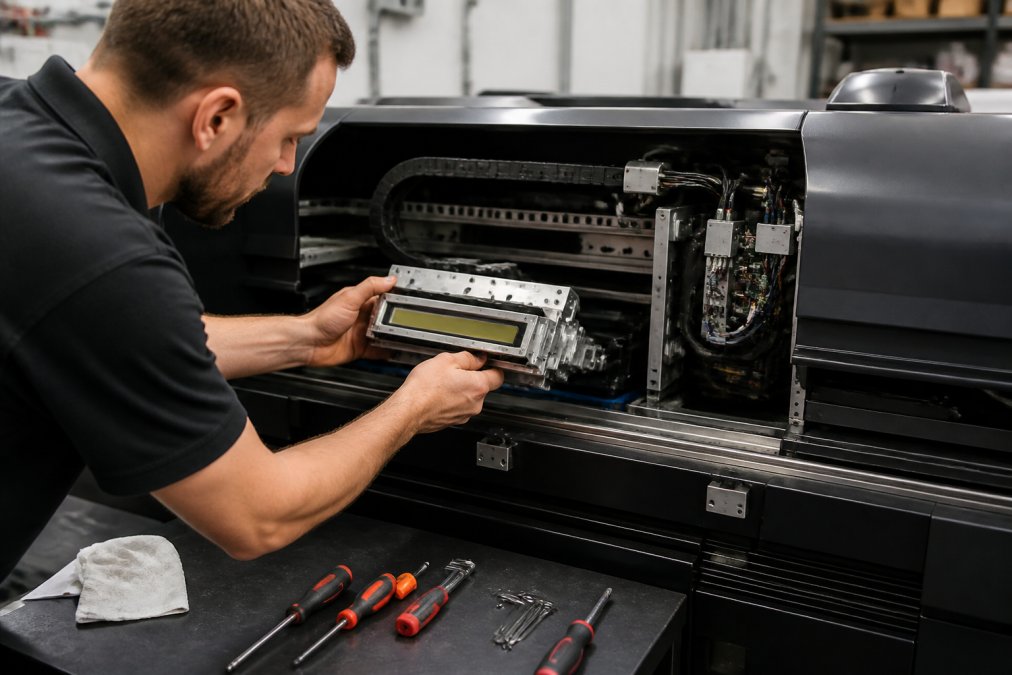
Retrofitting is not a universal plug-and-play solution. The wavelength output of the LED must match your ink chemistry, and the cooling requirements differ from mercury systems. A professional installation typically takes one to two days, including test prints and power calibration. The benefit is that you keep your existing printer frame and transport system, avoiding the capital cost of a brand-new machine.
Most operators who retrofit find they need to adjust their print profiles slightly, as LED curing is faster and produces less heat soak into the substrate. Once dialled in, the consistency of output often improves because LED intensity does not degrade over the lamp's life the way mercury arcs do.
Alternative 1: Full LED Lamp Replacement
The most straightforward UV printer lamp alternative for cost savings is a complete conversion to LED curing. This option replaces the entire curing system with a new LED array, either as a factory option on a new printer or as a full retrofit package.
The advantages are clear: dramatically lower energy consumption, no warm-up or cool-down time, and an expected lifespan measured in years rather than months. LED units also switch on and off instantly, which means you can power them down between jobs and save energy during idle periods. The print quality is consistent from the first metre to the last, with none of the gradual yellowing that signals a failing mercury bulb.
The trade-off is the initial outlay. An LED head costs more than a single mercury replacement lamp. However, when you price the LED against the number of mercury bulbs you would consume over the same period, plus the energy savings and reduced downtime, the total cost of ownership favours LED for most high-volume operations.
Alternative 2: Hybrid Curing Systems
Hybrid systems combine an LED array with a lower-powered mercury lamp, giving operators flexibility across different ink types and substrates. Some inks cure best under the broad spectrum of a mercury arc, while newer formulations are optimised for narrow-band LED output. A hybrid allows you to run both without changing machines.
This option suits print shops that handle a wide variety of jobs and cannot commit to a single ink chemistry. The operator selects the curing mode based on the job, switching between LED for fast, energy-efficient runs and mercury for specialised applications. The running costs sit between the two technologies, but the flexibility can justify the premium for mixed production lines.
The main drawback is complexity. You still carry the maintenance burden of a mercury lamp, including bulb replacement and ozone management, alongside the new LED electronics. For businesses with a consistent workload and standardised inks, a pure LED system is usually the more reliable UV printer lamp alternative. Hybrids earn their keep only when substrate and ink variety demand it.
Alternative 3: Refurbished Mercury Lamps
For operators who cannot justify the capital outlay of LED conversion, refurbished mercury lamps offer a budget-conscious stopgap. These are used lamps that have been tested, cleaned, and certified for a reduced operational life at a lower price point than new stock.
The appeal is immediate cost relief, and for low-volume or intermittent production, a refurbished lamp can keep a machine running while you plan a longer-term upgrade. The risk is that you inherit unknown history: a lamp may have been run hard, stored poorly, or be close to the end of its useful arc life. Failure rates tend to be higher, and the cost of an unplanned shutdown can quickly erase the initial saving.
Refurbished lamps are best treated as a bridging strategy, not a permanent solution. If you choose this route, source from a supplier who provides a warranty and documented test results. The few pounds saved upfront are not worth a week of halted production.
UV Printer Maintenance Tips to Extend Lamp Life
Whatever curing technology you run, consistent UV printer maintenance tips will protect your investment and delay replacement costs. The most common cause of premature lamp failure is contamination: dust and ink mist settle on the quartz surface, creating hot spots that crack the glass.
Wipe the lamp surface and reflector with the correct solvent on a scheduled basis, and check cooling fans and filters monthly. A lamp that overheats loses intensity and dies early, so keep airflow paths clear. Monitor your print output for signs of under-curing, which often signals a lamp nearing the end of its life before it fails completely.
Keep a spare lamp in stock if you run mercury, and log the hours each lamp accumulates so replacements happen on schedule, not in crisis. For LED systems, the maintenance burden is far lighter, but periodic cleaning of the window and checking the cooling circuit remains essential.
Choosing the Right Alternative for Your Production Line
Selecting the right UV printer lamp alternatives for cost savings depends on your production volume, ink types, and tolerance for downtime. A high-volume shop running standard inks will see the fastest payback from a full LED conversion. A versatile trade printer handling varied substrates may find the flexibility of a hybrid system worth the extra complexity.
| Option | Best For | Running Costs | Downtime Risk |
|---|---|---|---|
| Full LED Replacement | High-volume, consistent ink use | Lowest | Lowest |
| Hybrid Curing System | Mixed substrates and inks | Medium | Medium |
| Refurbished Mercury Lamp | Budget stopgap, low volume | High over time | Highest |
Consider your energy tariffs, your typical shift patterns, and how much a single hour of downtime costs your business. LED systems reward operators who run multiple shifts and want instant start-stop capability. Refurbished lamps only make sense as a temporary measure while you budget for a proper upgrade. We can assess your current setup and recommend the most cost-effective path, backed by expert repair and spare parts supply when you need them.
The cost of curing technology goes far beyond the price of a replacement bulb. Energy draw, maintenance hours, and unplanned downtime all shape the true operating cost of your UV printer. Upgrading to LED curing, whether through a full replacement or a hybrid system, delivers the most reliable long-term savings. Laserprints specialises in keeping UV print engines running at peak performance across the UK, offering expert servicing, rapid response, and high-quality spare parts. Shop now →
Frequently Asked Questions
Are LED UV lamps cheaper to run than mercury lamps?
Yes. LED UV lamps consume substantially less electricity because they convert a higher proportion of energy into curing light rather than heat. They also eliminate the need for continuous warm-up and cool-down cycles, so they only draw power during active printing. Over a typical production year, the energy savings alone can offset the higher upfront cost of an LED system, before factoring in reduced ventilation requirements and lower replacement frequency.
Can I retrofit my existing UV printer with LED lamps?
In most cases, yes, but compatibility depends on your print engine. A UV LED retrofit for printers typically requires matching the LED wavelength (commonly 385-395 nm) to your ink chemistry, plus installing new power supplies and cooling. Retrofits are usually more cost-effective than a full machine replacement. A specialist can assess your model and confirm whether the photoinitiators in your current inks will cure properly under LED light.
What is the lifespan difference between mercury and LED UV lamps?
Mercury arc lamps typically last between 1,000 and 2,000 hours before output degrades noticeably. LED arrays commonly deliver 20,000 hours or more of usable life, which means far fewer replacements and less downtime. That longer service life reduces both the purchase cost of replacement parts and the labour time spent on installation, making LEDs the lower-maintenance option over the full ownership period.
What are the main maintenance costs associated with UV printer lamps?
The recurring costs are replacement bulbs or LED arrays, reflectors that lose efficiency as they degrade, and cleaning of the quartz or glass surfaces where ink residue blocks light output. Mercury systems also require periodic checks on shutters and cooling fans. Regular cleaning and proper warm-up routines extend component life, so following structured UV printer maintenance tips reduces how often you need to buy parts.