

Table of Contents
- Why UV printer calibration matters for production
- How regular calibration reduces the cost of industrial printer downtime
- Colour accuracy and print quality gains from consistent calibration
- Identifying common UV printhead alignment issues before they escalate
- Establishing a UV printer maintenance schedule that prevents failure
- Extending printhead life through preventative calibration
- Getting the most from your calibration investment
- Frequently Asked Questions
Last Updated: September 18, 2026
Why UV printer calibration matters for production
UV printer calibration is the process of adjusting and verifying the alignment, colour accuracy, and performance parameters of your UV printing system to ensure consistent, high-quality output. When your printer drifts out of calibration, even slightly, the consequences ripple through your entire production workflow.
The real cost isn't just a few off-colour prints. It's the time your team spends troubleshooting, the jobs you have to rerun, and the reputation damage when a customer receives substandard work. Production managers at commercial printing companies know this well: a single miscalibrated machine can halt an entire shift's output.
When calibration is neglected, colours can shift gradually, print quality may degrade, and printheads can start to fail prematurely.
Regular UV printer calibration prevents these cascading failures. It keeps your equipment performing at design spec, maintains colour consistency across production runs, and extends the working life of expensive components. For operations running multiple shifts or handling time-sensitive orders, calibration isn't optional, it's the difference between meeting deadlines and missing them.
How regular calibration reduces the cost of industrial printer downtime
Unplanned downtime costs far more than most operations realise. Every hour your UV printer sits idle, you're losing production capacity, missing delivery windows, and potentially facing penalties for late orders.
When a printer runs out of calibration, it often triggers a cascade of problems. The printhead works harder to compensate, leading to accelerated wear. Colour drift forces reprints. Alignment issues cause banding or misregistration. What started as a minor calibration drift becomes a full breakdown that requires a technician visit and workshop repair.
Regular UV printer calibration intercepts this chain before it starts. By maintaining precise alignment and performance parameters, you prevent the secondary failures that turn a minor adjustment into major downtime. Your equipment runs at optimal efficiency, which means fewer mechanical stresses, fewer component failures, and fewer unplanned service calls.
The cost benefit compounds over time. A preventive approach costs significantly less than emergency repairs. When your printer does need attention, the Laserprints team can often resolve calibration-related issues remotely using our Remote Support Service, which minimises the need for costly on-site visits and keeps your production running.

Colour accuracy and print quality gains from consistent calibration
Print quality is measured in precision. For apparel decoration, signage, or speciality printing, colour consistency across runs is non-negotiable. Customers expect the same result whether they order 50 units or 500.
UV printer calibration ensures that colour output remains stable across production batches. When your printer is properly calibrated, the colour profile matches your design intent. Blacks stay true black. Bright colours maintain their saturation. Gradients transition smoothly without banding.
Without regular calibration, colour drift accumulates. A shift of just a few points in the colour space becomes noticeable to the human eye, especially when comparing a reprint to the original. This is particularly critical for brands with strict colour specifications. A logo that drifts even slightly can look unprofessional and damage brand trust.
Consistent calibration also improves registration accuracy. When print elements are properly aligned, text remains sharp, multi-colour designs layer correctly, and fine details stay crisp. Misaligned printheads cause ghosting, where colours appear slightly offset from where they should be.
The quality gains from regular UV printer calibration translate directly to customer satisfaction. Fewer reprints means faster turnaround. Consistent output means repeat business and positive reviews. For operations competing on quality, calibration is a competitive advantage.
Identifying common UV printhead alignment issues before they escalate
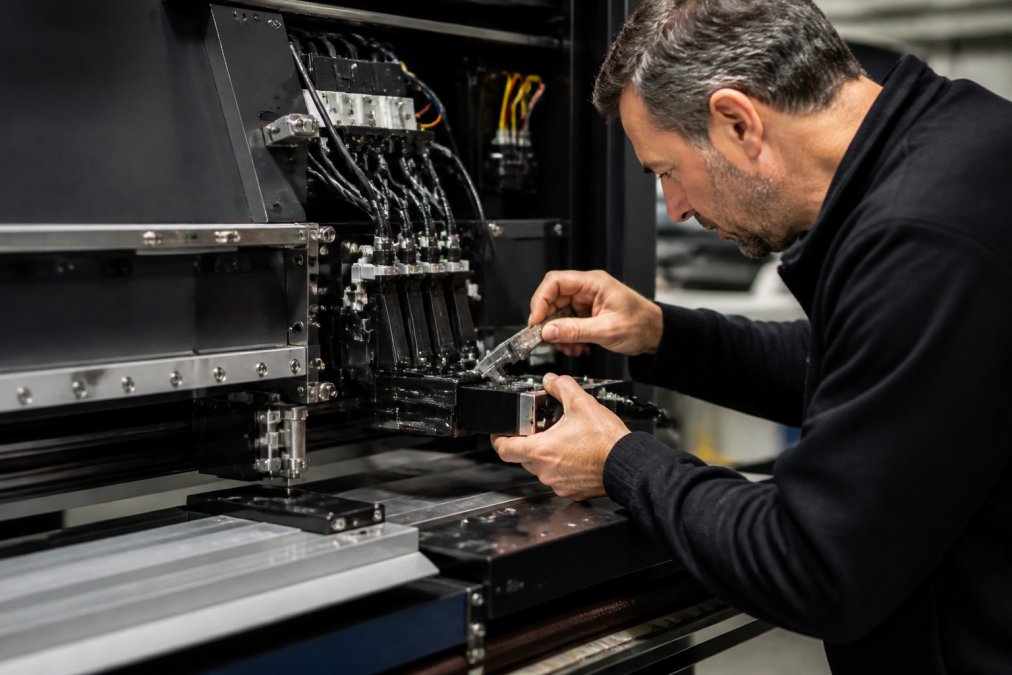
Printhead alignment problems are among the most common issues we encounter. The challenge is that they often start subtly. A slight misalignment might produce barely noticeable output degradation for weeks before becoming obvious.
Common warning signs include banding (visible horizontal lines across prints), colour separation where overlapping colours don't blend smoothly, and ghosting where printed elements appear slightly doubled. If you're seeing inconsistent ink saturation or colour shifts across the print width, alignment is likely the culprit.
Many facilities try to compensate by increasing ink density or adjusting colour profiles. This masks the symptom but doesn't fix the root cause. The printhead continues to drift, wear accelerates, and eventually you have a complete failure.
The key is catching alignment drift early. Regular test prints, simple colour bars and registration marks, reveal drift before it affects production quality. If your test prints show consistent spacing and colour accuracy, your alignment is holding. If you're seeing drift, that's your signal to recalibrate before running a full production job.
Establishing a UV printer maintenance schedule that prevents failure
A structured maintenance schedule is the foundation of reliable production. Without one, calibration happens reactively, only when something breaks, rather than proactively.
An effective schedule balances frequency with operational reality. Daily checks should include visual inspection for obvious issues and a simple test print to verify colour and alignment. Weekly, run a more thorough calibration check with test patterns that reveal drift. Monthly, perform a full recalibration and document the results.
The specific intervals depend on your usage. High-volume operations running multiple shifts daily need more frequent calibration than shops running single shifts. Equipment age matters too, older printers may need calibration more often as components naturally wear.
Documentation is critical. Keep records of every calibration: date, settings adjusted, test results, and any issues noted. Over time, this data reveals patterns. If your printer needs recalibration every two weeks, something else is wrong, perhaps environmental factors like temperature fluctuations, or a component that's beginning to fail.
Laserprints can help you build a maintenance schedule tailored to your specific equipment and production volume. Our team understands the practical constraints you face.
Extending printhead life through preventative calibration
Printheads are expensive components, and their lifespan is directly affected by how well your equipment is maintained. A printhead that's constantly working to compensate for misalignment wears out faster than one operating in proper alignment.
Preventative calibration reduces stress on the printhead. When your printer is properly aligned, ink flows smoothly and consistently. The printhead operates at design spec, not struggling against mechanical resistance. This dramatically extends working life.
Environmental factors also matter. Temperature fluctuations cause metal components to expand and contract, gradually shifting alignment. Humidity affects ink viscosity and can contribute to blockages. Regular calibration accounts for these environmental changes and keeps your printhead operating in the optimal window.
The cost of replacing a UV printhead can be substantial. Preventative maintenance that extends printhead life can offer significant savings.
If your printhead does eventually need cleaning or replacement, Laserprints offers Printhead Cleaning Service that can often recover performance from partially blocked nozzles, potentially extending the life of the printhead further before replacement becomes necessary.

Getting the most from your calibration investment
Calibration is an investment in reliability and quality, but only if you approach it strategically. Simply running a calibration routine and moving on misses the opportunity to gather intelligence about your equipment's condition.
Each calibration session should include documentation. What settings changed? How much drift occurred since the last calibration? Are certain parameters drifting more than others? This information tells you whether your equipment is stable or developing problems.
Use calibration data to predict future maintenance needs. If drift is accelerating, something is wearing and will need attention soon. If drift is minimal and stable, your maintenance schedule is working. This predictive approach lets you schedule repairs during planned downtime rather than experiencing emergency failures.
Invest in proper calibration tools and test materials. Generic test prints aren't sufficient for precision work. Proper colour reference standards and alignment test patterns reveal issues that simple visual inspection misses.
Finally, calibration is most effective when combined with broader preventative maintenance.
| Calibration Interval | Best For | Key Benefit |
|---|---|---|
| Daily test print | All operations | Early detection of drift |
| Weekly full calibration | High-volume shops (40+ hrs/week) | Maintains colour consistency |
| Monthly recalibration | Standard operations (20-40 hrs/week) | Prevents quality degradation |
| Quarterly deep check | Low-volume shops (<20 hrs/week) | Catches emerging issues early |
Frequently Asked Questions
How often should a professional UV printer be calibrated?
Most commercial UV printers should be calibrated every 2-4 weeks during regular production, or immediately after any printhead replacement, firmware update, or significant temperature change. High-volume operations may benefit from weekly checks. The specific interval depends on your usage volume, ambient conditions, and the precision demands of your work. Establishing a UV printer maintenance schedule tailored to your production cycles prevents drift before it affects output quality.
What are the signs that my UV printer needs recalibration?
Watch for colour shifts between prints, uneven ink distribution, banding or striping patterns, and misaligned layers in multi-pass printing. If your whites appear yellowed or colours look dull compared to previous jobs, recalibration is overdue. Common UV printhead alignment issues also include visible gaps between colour channels and inconsistent coverage. Addressing these early through recalibration prevents more costly repairs and maintains production schedules.
Does regular calibration reduce ink wastage in UV printing?
Yes. Properly calibrated printers use ink more efficiently because the nozzles fire at precise intervals and the printhead sits at the correct distance from the substrate. Misaligned or drifting printers compensate by applying excess ink to achieve colour targets, wasting material and increasing costs. Over time, consistent calibration can help reduce ink consumption whilst maintaining or improving print quality, directly offsetting the cost of maintenance.
Can poor calibration affect the lifespan of UV printheads?
Absolutely. Printheads under stress from poor calibration work harder to produce acceptable output, causing premature wear and nozzle blockages. Misalignment forces the printhead to compensate with excessive ink flow, which accelerates internal deposits and electrical strain. Regular calibration keeps the printhead operating within design specifications, extending its working life by months or even years and avoiding the cost of industrial printer downtime caused by unexpected failure.