

Table of Contents
- UV vs Solvent Printer Maintenance: Overview and Comparison Table
- UV Printer Maintenance Requirements
- Solvent Printer Maintenance Requirements
- UV Printer Printhead Cleaning Best Practices
- Industrial Printer Preventative Maintenance Schedule
- Common Industrial Printer Repair Issues
- Maintenance Costs and Tools Required
- Which Printer Type Demands Less Maintenance?
- Frequently Asked Questions
Last Updated: September 23, 2026
UV vs Solvent Printer Maintenance: Overview and Comparison Table
UV and solvent printer maintenance demands differ fundamentally in frequency, complexity, and cost. Understanding these differences is critical for production managers and facility operators who need to minimise downtime and extend equipment life. According to manufacturing industry best practices on equipment maintenance, preventive maintenance schedules reduce unplanned breakdowns by 40-50% across industrial printing operations.
UV printers cure ink instantly using ultraviolet light, whilst solvent printers rely on evaporation and absorption into substrates. This fundamental difference cascades into cleaning protocols, component replacement schedules, and troubleshooting approaches.
The maintenance profiles of UV and solvent printers are distinctly different, depending on your operation's scale and substrate variety.
| Maintenance Task | UV Printer | Solvent Printer | Frequency Difference |
|---|---|---|---|
| Printhead cleaning | Weekly nozzle checks | Daily flushing cycles | Solvent requires more frequent intervention |
| Ink system purging | Monthly | Every 2-3 weeks | Solvent ink degrades faster |
| Curing lamp inspection | Quarterly | Not applicable | UV-specific requirement |
| Substrate vacuum system | Weekly | Daily | Solvent relies more heavily on vacuum |
| Ink cartridge replacement | Every 4-6 weeks | Every 2-3 weeks | Solvent consumes ink faster |
| Environmental controls | Moderate humidity control | Strict ventilation + humidity | Solvent demands more environmental management |
UV Printer Maintenance Requirements
UV printers require consistent but less labour-intensive maintenance than solvent systems. The ultraviolet curing process eliminates evaporation problems but introduces demands around lamp performance and printhead management.
Daily and Weekly Tasks
Start each shift with a visual inspection of the UV curing lamp. Check for discolouration, dimming, or flickering, early warning signs of lamp degradation.
Run a nozzle plate cleaning cycle every morning before production begins (10-15 minutes). This clears overnight ink residue that may have begun to solidify in the nozzles.
Weekly, perform a full printhead health check using your RIP software's diagnostic tools. Print a nozzle verification pattern to reveal which nozzles are firing correctly. If you spot weak nozzles, schedule deeper cleaning before they become completely blocked.
Check the substrate vacuum system weekly for ink buildup, dust, or debris. Weak vacuum leads to misaligned prints and wasted material.
Monthly and Quarterly Servicing
Monthly, check the lamp's operating hours. Order a replacement when approaching 80% of rated life to avoid mid-production failure.
Inspect ink lines and fittings for leakage or crystallisation. UV inks can harden inside lines if unused. Hardened ink around connection points indicates the line needs flushing or replacement.
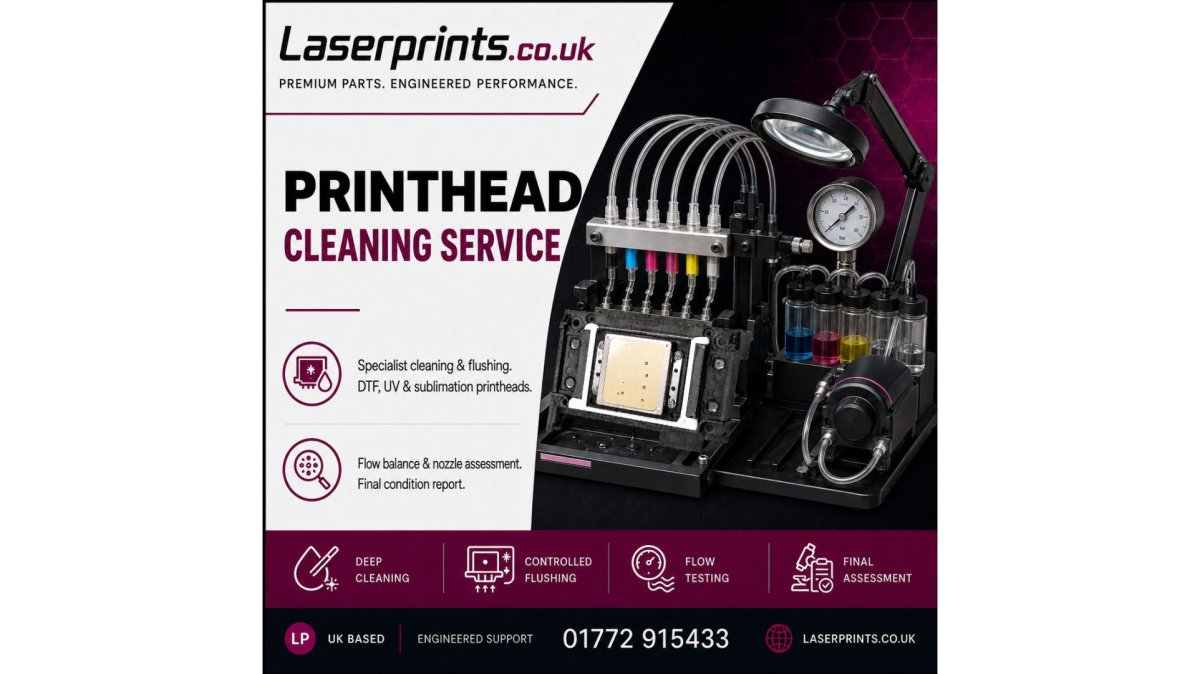
Quarterly, perform a full printhead deep clean. This is more intensive than the daily maintenance cycle and typically requires sending the printhead to a specialist service like Laserprints' Printhead Cleaning Service. The process includes controlled chemical cleaning, directional flushing of ink channels, nozzle plate cleaning, and flow testing. This service costs £49.99 and typically takes five working days, making it far cheaper than replacing a blocked printhead entirely.
Quarterly maintenance also includes checking electrical connections, cooling systems, and safety interlocks.
Solvent Printer Maintenance Requirements
Solvent printers demand more frequent and hands-on maintenance because solvent inks degrade faster in ink lines, clog nozzles more readily, and create more maintenance overhead.
Daily and Weekly Tasks
Run a full ink system purge every working day (20-30 minutes). This flushes solvent through all lines, the printhead, and waste system to prevent overnight hardening. Skipping even one day dramatically increases blockage risk.
Daily substrate vacuum checks are essential. Solvent inks don't adhere as strongly as UV inks, so vacuum pressure must be precise. Weak vacuum leads to substrate movement and ruined alignment.
Weekly, inspect ink lines for crystallisation or discolouration. Heavy buildup indicates the line needs flushing or replacement.
Run a nozzle check twice weekly. Solvent printers are prone to nozzle drift, where individual nozzles gradually underperform. Early detection prevents cascading blockages.
Monthly and Quarterly Servicing
Monthly, perform a full ink line flush using specialist solvents. This typically takes 2-3 hours in-house or is often outsourced.
Replace solvent cartridges every 2-3 weeks depending on print volume. Solvent ink degrades as it sits, so replace partially-used cartridges on schedule.
Quarterly, remove and inspect the printhead. Check the nozzle plate under magnification for damage, cracks, or excessive buildup. Damaged nozzle plates require printhead replacement.
Quarterly, inspect the ventilation system. Check that extraction is pulling air away from the operator and no solvent vapour lingers in the workspace.
Monthly, verify environmental controls. Solvent ink requires 40-60% relative humidity and 18-25°C ambient temperature. Drift outside this range degrades ink performance.
UV Printer Printhead Cleaning Best Practices
UV printer printhead cleaning focuses on prevention and gentle intervention, whilst solvent systems require more aggressive flushing to combat ink degradation.
For UV printers, prevent blockage rather than cure it. Run nozzle checks consistently and act on the first sign of weakness. If a nozzle fires at 80% strength, clean immediately.
Use only the manufacturer-specified cleaning solution for UV printheads. Using the wrong agent damages nozzle plates or leaves residue. Start with the gentlest cleaning intensity and escalate only if needed.
If severely blocked, professional cleaning services like Laserprints' (£49.99) are cost-effective and recover performance in most cases where damage isn't permanent.

Never manually clean a UV printhead without explicit training. Mishandling delicate nozzle plates causes permanent damage.
Industrial Printer Preventative Maintenance Schedule
A structured preventative maintenance schedule prevents catastrophic failures. Consistent small interventions are universal across printer types.
For UV printers, the schedule looks like this:
Daily: Nozzle check, visual lamp inspection, vacuum system check. Weekly: Full printhead health diagnostic, substrate platform inspection. Monthly: Ink line inspection, lamp operating hours review. Quarterly: Professional printhead cleaning service, lamp and cooling system inspection. Annually: Complete system overhaul, consumables replacement, firmware updates.
For solvent printers: Daily: Full ink system purge, nozzle check, substrate vacuum check, ink line visual inspection. Weekly: Second nozzle check, environmental condition verification, waste system emptying. Monthly: Full ink line flush, cartridge replacement, ventilation system inspection. Quarterly: Printhead removal and inspection, extraction duct cleaning, environmental control calibration. Annually: Complete system overhaul, nozzle plate replacement if needed, RIP software update.
Common Industrial Printer Repair Issues
Understanding the most common repair issues helps you spot problems early and decide whether to attempt in-house fixes or call a specialist.
Printhead blockage is the number-one issue for both UV and solvent printers. For UV systems, blockage develops from inconsistent cleaning. For solvent printers, blockage happens overnight if the daily purge is skipped. Partial blockage responds to cleaning cycles; complete blockage requires professional service or replacement.
Ink line leaks occur when fittings loosen or lines develop micro-cracks. Solvent lines are more prone to this. If you spot a leak, turn the machine off immediately and don't restart until the line is replaced.
Vacuum system failure manifests as substrate slipping or uneven pressure. Clear blockages in vacuum channels and check connections. If vacuum still won't hold, the pump may be failing and professional service is needed.
Curing lamp degradation (UV printers only) shows as uneven curing, incomplete ink hardening, or visible dimming. Quarterly lamp inspections catch this before print quality suffers.
Environmental control failures cause ink performance issues. If prints show colour shifts, banding, or adhesion problems, check humidity and temperature first.
For reactive repairs when breakdowns occur, Laserprints offers a Call-Out Service for on-site diagnosis and repair at £125.00. A qualified engineer attends your site, diagnoses the fault, and repairs the machine where possible. If specialist parts or workshop repair is needed, the engineer explains the next steps clearly.
Maintenance Costs and Tools Required
The cost difference between UV and solvent printer maintenance is substantial over a year.
UV printer maintenance costs typically include:
- Cleaning solution: £15-30 per bottle (2-3 months)
- Replacement lamps: (every 12-18 months)
- Professional printhead cleaning: £49.99 per service, 2-4 times per year
- Spare parts:
- Annual total: £400-800 for typical mid-volume operation
Solvent printer maintenance costs typically include:
- Cleaning solution and flushing solvents:
- Ink cartridges:
- Ink line replacements:
- Ventilation system maintenance:
- Professional printhead cleaning: £49.99 per service (4-6 times per year)
- Waste system emptying and disposal:
- Annual total: £2,000-3,500 for typical mid-volume operation
Which Printer Type Demands Less Maintenance?
The answer depends on your production profile. UV printer maintenance demands less frequent intervention but requires more precision when problems do occur. Solvent printers demand constant daily attention but often have more forgiving failure modes.
Frequently Asked Questions
Does a UV printer require more maintenance than a solvent printer?
UV printers typically require more frequent maintenance than solvent printers, particularly around the UV curing system and printhead nozzles. UV lamps degrade over time and need regular inspection, whilst solvent printers face more ink-related blockages from their thicker inks. Both require consistent attention, but UV systems demand stricter schedules to maintain output quality and prevent curing inconsistencies.
What are the best practices for UV printer printhead cleaning?
UV printer printhead cleaning should be performed weekly using manufacturer-approved cleaning solutions. Avoid aggressive flushing that can damage nozzles. For blocked or contaminated printheads, professional cleaning services like Laserprints' Printhead Cleaning Service (£49.99) use controlled chemical cleaning and directional flushing to recover nozzle performance. This workshop-based service typically completes within five working days and can extend printhead life significantly.
How often should I schedule an industrial printer preventive maintenance plan?
An industrial printer preventive maintenance schedule should include daily nozzle checks, weekly cleaning cycles, and monthly component inspections. Quarterly deep servicing is recommended for both UV and solvent systems. This proactive approach prevents costly downtime, reactive repairs often cost significantly more than scheduled maintenance. Remote support (£24.99) or on-site call-out services (£125.00) can diagnose issues before they escalate into production failures.
What are the most common industrial printer repair issues I should watch for?
Common industrial printer repair issues include printhead blockages, ink system failures, UV lamp degradation, and firmware errors. Solvent printers often experience ink crystallisation, whilst UV printers suffer from curing inconsistencies. Early detection through preventive maintenance prevents extended downtime. If issues arise, an in-house machine repair service (£100.00) provides thorough diagnosis and repair, typically completed within 2-3 working days from delivery.