

Table of Contents
- What a UV Printer Maintenance Service Actually Covers
- UV Printer Maintenance Service Pricing: What You Pay in 2026
- The Average Cost of Industrial Printer Repair and What Drives It
- UV Printer Preventive Maintenance Checklist for Production Teams
- Benefits of Annual UV Printer Service Contracts
- Parts Pricing: Where Maintenance Budgets Quietly Leak
- How to Choose a Maintenance Provider and Avoid Repeat Failures
- Frequently Asked Questions
Last Updated: September 12, 2026
What a UV Printer Maintenance Service Actually Covers
A UV printer maintenance service is a scheduled programme of inspection, cleaning, calibration and parts replacement carried out on a UV-cure print engine to keep it producing saleable output. At Laserprints, we treat servicing as two distinct activities: work you plan, and work you can't.
Routine servicing covers nozzle checks, cap top inspection, wiper and capping station cleaning, ink damper checks, UV lamp and curing verification, belt tension, encoder strip cleaning and firmware or RIP configuration reviews. Reactive repairs cover whatever breaks between those visits: a failed printhead, a blocked ink line, a curing fault, a board failure.
The distinction matters because they're priced completely differently, and most pricing confusion comes from mixing the two.
Routine Servicing vs Reactive Repairs
Routine servicing is predictable and cheap. Reactive repairs are unpredictable and expensive, partly because they always arrive at the worst moment.
A planned visit follows a fixed checklist and produces a report. A breakdown call-out starts with diagnosis, and diagnosis is where the clock starts running. If your team only ever books reactive work, you're paying premium rates for problems that a scheduled inspection would have caught.
UV Printer Maintenance Service Pricing: What You Pay in 2026
Pricing for UV printer maintenance service splits into three delivery models, and the right one depends on what's actually wrong. Remote support is the cheapest entry point, workshop repair sits in the middle, and on-site attendance carries a premium because an engineer's travel time is billable.

Here's how Laserprints structures it:
| Service | Price | Best For | Turnaround |
|---|---|---|---|
| Remote Support Service | £24.99 | RIP, driver and software faults | Same session |
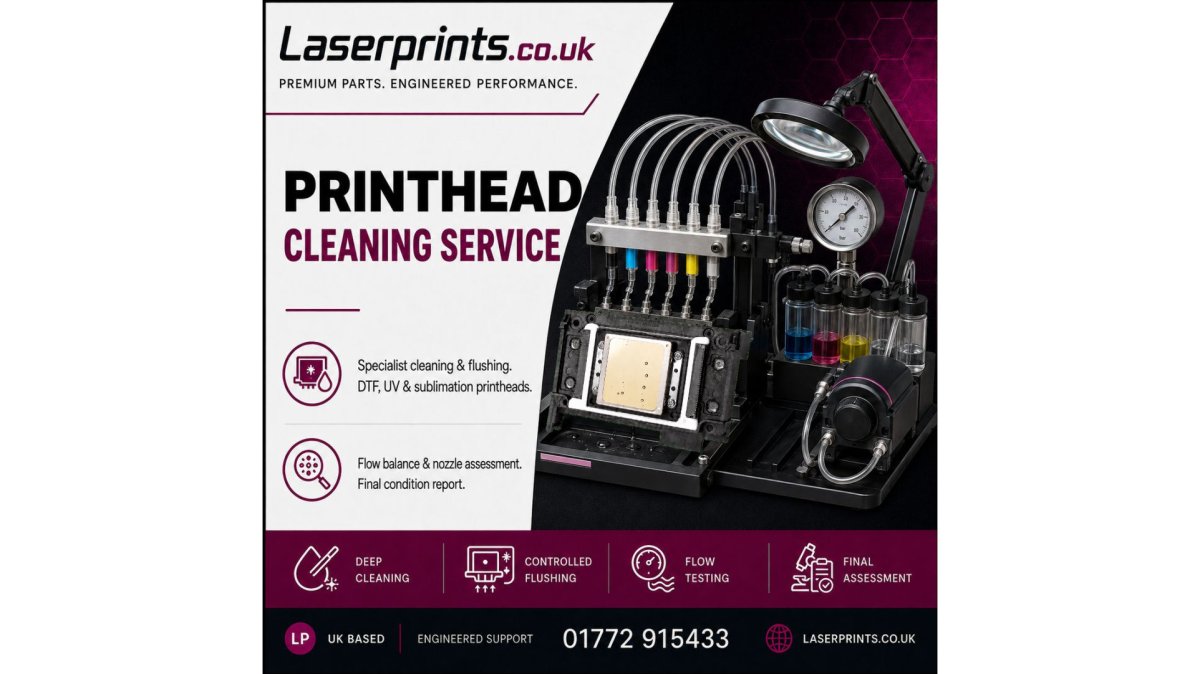
| Printhead Cleaning Service | £49.99 | Blocked or contaminated printheads | Around 5 working days |
| In-House Machine Repair Service | £100.00 | DTF and UV printers delivered to workshop | Usually 2-3 working days |
| Call-Out Service | £125.00 | Breakdowns that need an engineer on site | Booked attendance |
Workshop, On-Site and Remote Rates Explained
Remote support is the cheapest option because no one travels. If your fault is software-shaped, a misfiring RIP profile or a driver that won't talk to the machine, a session at £24.99 resolves it without downtime beyond the call itself.


Workshop repair at £100.00 removes travel charges entirely, because you deliver the machine. That's the trade: your time and transport against a lower rate and a controlled repair environment.
On-site attendance at £125.00 is for machines that can't practically be moved, or faults that only appear under production conditions. A common mistake is booking a call-out for something a remote session would have fixed in twenty minutes.
The Average Cost of Industrial Printer Repair and What Drives It
The average cost of industrial printer repair is less useful as a single figure than as a set of drivers. Two identical faults on two identical machines can land at very different prices depending on parts availability, access, and whether the fault was caught early.
The drivers, in rough order of impact:
- Parts required. A cap top seal is a few pounds. A printhead is a different order of magnitude entirely.
- Access. A machine against a wall with no clearance takes longer to work on than one with space around it.
- Diagnosis accuracy. A misdiagnosed fault means paying twice (bsigroup.com).
- Urgency. Emergency attendance costs more than a booked visit.
- Machine type. UV, DTF, sublimation and laser systems each have their own failure patterns.
This is why a fixed call-out rate is more honest than a vague hourly estimate. You know the attendance cost before the engineer arrives, and parts are quoted separately for approval.
UV Printer Preventive Maintenance Checklist for Production Teams
A UV printer preventative maintenance checklist is the single highest-return document in a print shop. It converts vague worries into a repeatable daily and weekly routine that anyone on the floor can follow.
Daily
- Run a nozzle check before the first job
- Wipe the capping station and check the cap top seal sits cleanly
- Confirm UV lamp output and curing on a test substrate
- Check ink levels and damper condition for air ingress
Weekly
- Clean the encoder strip and check for ink mist build-up
- Inspect wiper blades for wear or deformation
- Check belt tension and carriage movement for roughness
- Verify waste ink levels and lines
Monthly
- Inspect ink dampers and replace if flow is inconsistent
- Check cap top seals for hardening or splitting
- Review firmware and RIP versions against current releases
- Log every fault, however minor, for pattern spotting
Replacement cap tops and dampers are inexpensive insurance. An I3200 printhead cap top seal costs £14.99, an XP600 UV ink damper £12.49, and an L800 L805 cap top £8.32. Compare that to the cost of a printhead replacement and the maths does itself.
Benefits of Annual UV Printer Service Contracts
The benefits of annual UV printer service contracts come down to one thing: moving cost from unpredictable to predictable. A contract converts random breakdown bills into a known monthly figure and a scheduled visit you can plan production around.
What a contract typically delivers:
- Fixed servicing intervals, so nothing gets forgotten during a busy quarter
- Priority response when something does fail
- A documented service history, which matters at resale and for warranty discussions
- Early warning on wear items before they cause a failure
The counterargument is real: if nothing breaks, you've paid for visits you didn't strictly need. That's true, and it's why contracts suit high-utilisation machines far more than occasional-use ones. A machine running double shifts will always justify scheduled servicing (hse.gov.uk). A machine that runs twice a month may not.
Parts Pricing: Where Maintenance Budgets Quietly Leak
Consumable parts are where maintenance budgets disappear without anyone noticing. Nobody queries a £12 damper, but twenty of them across a year, plus cap tops, wipers and cleaning fluid, adds up to a real line item.
The trap is buying cheap pattern parts that don't seal properly. A cap top that doesn't form a clean seal around the nozzle plate causes suction problems, recurring missing nozzles and dried ink, which is exactly the failure it was bought to prevent (epson.co.uk).
Genuine-fit parts for common Epson printhead platforms stay affordable:
| Part | Platform | Price |
|---|---|---|
| I3200 Cap Top Seal, Landscape Fitting | Epson I3200 | £14.99 |
| L1800 R1390 Printhead Cap Top Seal | Epson L1800 / R1390 | £12.49 |
| XP600 Printhead Cap Top Seal | Epson XP600 | £8.32 |
If you're unsure which fitting your machine takes, send your printer model and a photograph of the existing part. Capping assemblies vary between manufacturers even on the same printhead platform, and portrait versus landscape fittings are not interchangeable.
How to Choose a Maintenance Provider and Avoid Repeat Failures
Choosing a provider is mostly about diagnosis quality and parts logistics, not price. The cheapest call-out is worthless if the engineer guesses, replaces the wrong component, and you pay twice for the same fault.
Ask these questions before committing:
- Can they cover every engine you run? If you operate laser, DTF and UV machines, one provider beats three separate relationships.
- What's the realistic parts lead time? A machine sitting idle waiting for a part is costing more than the part.
- Do they stand behind the diagnosis? Ask what happens if the first repair doesn't resolve the fault.
- Can they support remotely first? A provider who jumps straight to a site visit isn't saving you money.
- Will they show you the test prints? Before a machine leaves a workshop, you should see nozzle checks and test output.
A misdiagnosis is the most common reason teams end up on their third provider in two years. Insist on a clear explanation of what was found, what was replaced, and why.
Downtime is the real cost in UV printing, not the service invoice. A machine that's idle for a week loses far more than any maintenance contract would have charged, and the failure usually traces back to a part that cost less than a round of coffees. Laserprints handles repair, servicing and spare parts across laser, DTF and UV print engines, with remote support from £24.99, workshop repair from £100.00 and on-site call-outs from £125.00. If you want a provider who diagnoses properly, explains the findings and keeps your production running, get started with Laserprints and put a maintenance plan behind your print floor.
Frequently Asked Questions
How often should a professional UV printer be serviced?
Most production UV printers need a full service every six to twelve months, but high-volume shops doing daily shifts should plan on a six-month interval. Between services, daily nozzle checks and weekly printhead cleaning keep the machine stable. The cap top seal and ink damper are the parts most likely to need replacing at each service, and both cost under £15 from Laserprints, so the consumable side of servicing is cheap compared with a single lost production day.
What factors influence the cost of UV printer maintenance?
Four things move the price most: whether the fault is software or hardware, whether the machine can be worked on remotely or needs a site visit, whether parts are in stock, and how far the engineer has to travel. A remote support session at Laserprints costs £24.99, a workshop repair is £100, and a call-out is £125. Printhead condition is the biggest single variable, because a fully blocked head that cannot be recovered means replacement rather than cleaning.
What is included in a standard UV printer service contract?
A typical contract covers scheduled inspections, printhead and capping station cleaning, ink system checks, firmware and RIP software updates, and priority response when a breakdown happens. It normally excludes accidental damage, printhead replacement and consumable parts, which are quoted separately. Ask any provider to put the response time in writing, because the benefits of annual UV printer service contracts depend entirely on how fast an engineer reaches you when production stops.
Is it cheaper to perform in-house maintenance or hire a professional?
Daily and weekly tasks such as nozzle checks, cap top cleaning and ink damper inspection are worth doing in-house. Anything involving printhead recovery, capping station alignment or electrical faults is not, because a misdiagnosis can turn a £49.99 printhead clean into a full replacement. The practical split is to handle routine care yourself and book professional servicing for the annual deep clean and any fault you cannot reproduce reliably.
What are the signs that your UV printer requires an urgent service?
Persistent missing nozzles after two cleaning cycles, ink pooling around the capping station, banding that does not clear with a nozzle check, and error codes on startup all point to a fault that will get worse. A worn cap top seal or a blocked ink damper causes most of these symptoms, and both are cheap to replace. If the machine is still producing saleable output, book a workshop repair rather than waiting for a full breakdown.
How can I reduce long-term UV printer repair costs?
Track the average cost of industrial printer repair across your own machines rather than relying on industry averages, and replace low-cost wear parts on a schedule instead of waiting for failure. Cap top seals and ink dampers cost between £8.32 and £14.99, while a neglected printhead can cost hundreds to replace. Keeping a small stock of these parts on site means a fault is fixed in hours, not days.