

Table of Contents
- Why Signage Production Support Matters for Your Business
- Signmaster Alternatives for Printer Repairs
- Commercial Signage Maintenance Best Practices
- How to Evaluate Print Service Provider Reliability
- Our Approach to Signage Production Support
- Response Times and Service Flexibility
- Getting Started with Reliable Support
- Frequently Asked Questions
Last Updated: 31 August 2026
Why Signage Production Support Matters for Your Business
When your laser, DTF, or UV printer stops working, production doesn't pause gracefully, it collapses. A single day of downtime can cost thousands in lost orders, missed deadlines, and frustrated clients (peer-reviewed research). This is why signage production support isn't a luxury for most UK print operations; it's a critical business function that separates profitable shops from those constantly chasing their tails.
The reality is brutal: equipment failures happen at the worst possible moments. Your busiest season, your tightest deadline, your most important client order, that's when something breaks. Without reliable support, you're left improvising repairs, watching profit margins evaporate, or worse, losing customers to competitors who can actually deliver on time.
Laserprints understands this pressure because we work with production managers, operations teams, and print shop owners who live it every day. We've built our entire operation around one principle: getting your equipment back online fast, and keeping it running reliably long-term. That's what signage production support actually means in practice, not just fixing problems when they occur, but preventing them before they become emergencies.
The businesses that thrive aren't the ones with the newest equipment. They're the ones with the best support partnerships. They've eliminated the uncertainty. They know exactly who to call, how quickly help arrives, and that the work will be done right the first time.
Signmaster Alternatives for Printer Repairs
If you've relied on Signmaster or similar providers and found yourself frustrated with response times, inconsistent quality, or technicians who don't understand your specific equipment, you're not alone. Many print shops reach a breaking point where they realise their current support arrangement isn't working anymore.
The problem isn't always that these providers are incompetent, it's that they're stretched too thin. When a support company tries to service every type of printer, every brand, every technology, something suffers. Either they take weeks to get someone out, or they send a technician who's competent with one machine but struggles with yours.
This is where specialisation matters. A support provider focused specifically on laser machines, DTF printers, and UV engines knows these systems inside and out. They understand the common failure points, they carry the right spare parts, and they can diagnose problems faster because they've seen them hundreds of times before.
Laserprints operates as a signage production support specialist. We don't try to be everything to everyone. We focus entirely on the equipment that matters to your operation: professional-grade laser systems, DTF printers for high-volume apparel work, and UV print engines for specialised applications. That focus means faster diagnosis, better outcomes, and technicians who actually understand your workflow.
The difference shows up in response times. When you call, you're not waiting in a queue behind twenty other shops. You're talking to someone who knows exactly what you need and can either fix it remotely or dispatch an engineer who arrives prepared.
Commercial Signage Maintenance Best Practices
Equipment doesn't fail randomly. It fails because warning signs were missed, maintenance was deferred, or the wrong person was troubleshooting the problem. The best print shops don't wait for failure, they prevent it through structured maintenance.
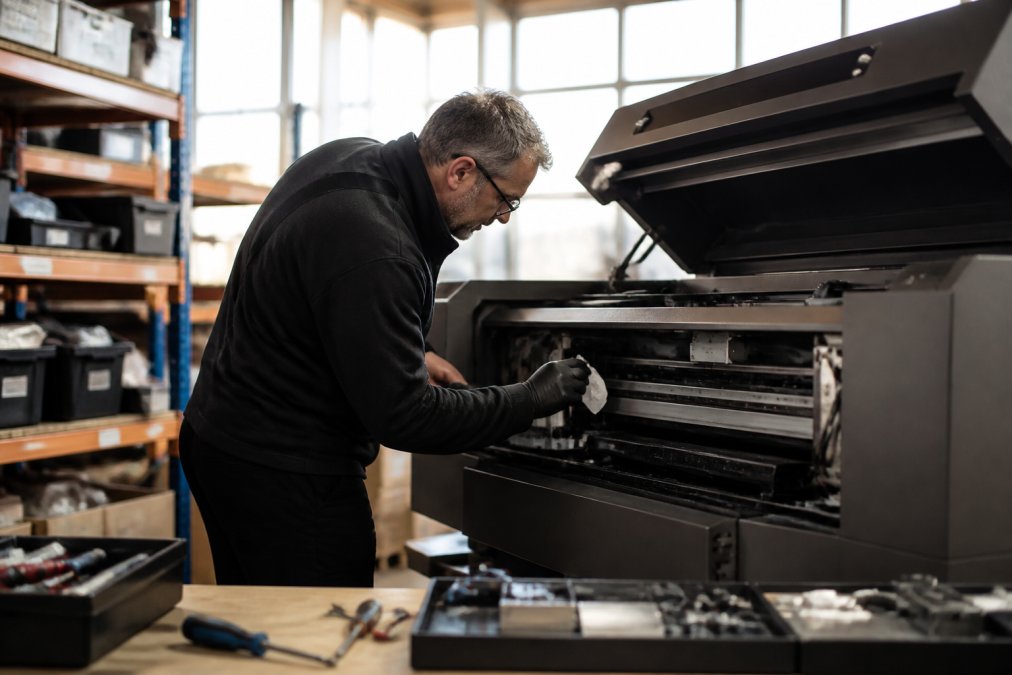
Preventative maintenance is the foundation. This means regular cleaning cycles, firmware updates, component inspections, and replacing wear items before they fail. For DTF printers, this includes printhead maintenance and ink circulation checks (iso.org). For laser systems, it means lens cleaning and calibration verification. For UV engines, it involves curing lamp inspection and cooling system checks.
A common mistake is treating maintenance as an optional expense. Print shop owners often think: "If the machine is working fine, why spend money on maintenance?" The answer is simple, because the cost of maintenance is a fraction of the cost of downtime. One emergency repair that takes three weeks costs more than a year of preventative maintenance (peer-reviewed research).
The second best practice is documentation. Keep records of every service call, every repair, every replacement part. This history tells you what's failing, what patterns are emerging, and what equipment might need replacement soon. It also protects you if a technician disputes whether work was actually done.
Third is having a clear escalation path. Know who to call for different types of problems. Know the difference between something you can fix in-house and something that requires professional intervention. Attempting to repair complex industrial printers without the right knowledge often makes problems worse, not better.
Laserprints offers preventative maintenance guidance for professional print equipment that helps shops establish these routines. Our team has seen what works and what doesn't across hundreds of operations, and we share that knowledge freely because it reduces emergency calls and keeps your equipment performing.
How to Evaluate Print Service Provider Reliability
Not all support providers are equal. Some will disappear when you need them most. Others will charge premium rates for basic work. Evaluating print service provider reliability before you need emergency help is the smartest decision you can make.
Start with response time commitments. Ask prospective providers: "What's your average response time for a call-out?" Get a specific answer, not a vague promise. Then ask: "What happens if you can't meet that time?" A reliable provider will have a backup plan. They'll either have multiple engineers, or they'll have partnerships with other specialists who can step in.
Second, ask about their technical depth. Can they service all three equipment types your shop uses, or do they specialise? If they specialise, that's actually a good sign, it usually means deeper expertise. If they claim to handle everything equally well, that's a red flag. Ask for references from shops running the same equipment you use.
Third, check their parts availability. A support provider who has to order parts and wait for delivery is going to leave you idle. Ask: "Do you stock common replacement parts? How quickly can you source parts that aren't in stock?" This matters enormously when you're down.
Fourth, understand their pricing model. Is it call-out based, contract-based, or hourly? What's included and what costs extra? A transparent pricing structure means no surprises when the bill arrives. Some providers offer fixed monthly retainers that include a certain number of service calls, this removes uncertainty and often works out cheaper than pay-per-call.
Fifth, verify their credentials and insurance. They should be insured for the work they do, and they should be able to show you evidence. If something goes wrong during a repair and they're not insured, you're liable.
Finally, trust your instinct about communication. When you call with a problem, do they listen carefully or rush you? Do they explain what they're doing and why? A provider who communicates clearly is usually one who will do quality work.
Our Approach to Signage Production Support
At Laserprints, we've structured our entire operation around the reality of UK print manufacturing. We know that your equipment downtime is our problem, and we treat it that way.
Our approach to signage production support starts with specialisation. We focus exclusively on laser machines, DTF printers, and UV print engines. That's not a limitation, it's our strength. Our engineers have spent years working with these specific systems, understanding their quirks, knowing what fails and why, and having the expertise to fix problems that would stump a generalist technician.
We offer multiple service options because we understand that different situations require different solutions. If your machine has a software issue or a simple diagnostic problem, our [remote support service(/products/remote-support-service) allows expert engineers to connect via secure video link and guide you through troubleshooting | laserprints.co.uk/products/remote-support-service], often solving the problem without anyone leaving their workshop. This costs £24.99 and is frequently all that's needed.
For problems that require hands-on work, we offer on-site call-out service where a qualified engineer attends your premises to diagnose and repair your equipment. This is £125.00 for the call-out, and we'll diagnose the problem and repair it if possible during the visit. If parts are needed, we source them quickly.
If you prefer to bring equipment to us, our in-house machine repair service accepts DTF and UV printers for comprehensive repair, maintenance, and servicing in our workshop at £100.00. This works well for shops that aren't in immediate crisis and want thorough, detailed work.
We also offer specialised services like printhead cleaning for partially blocked or ink-contaminated printheads at £49.99. Many problems that look like major failures are actually just blocked printheads, we can often restore full function without expensive component replacement.
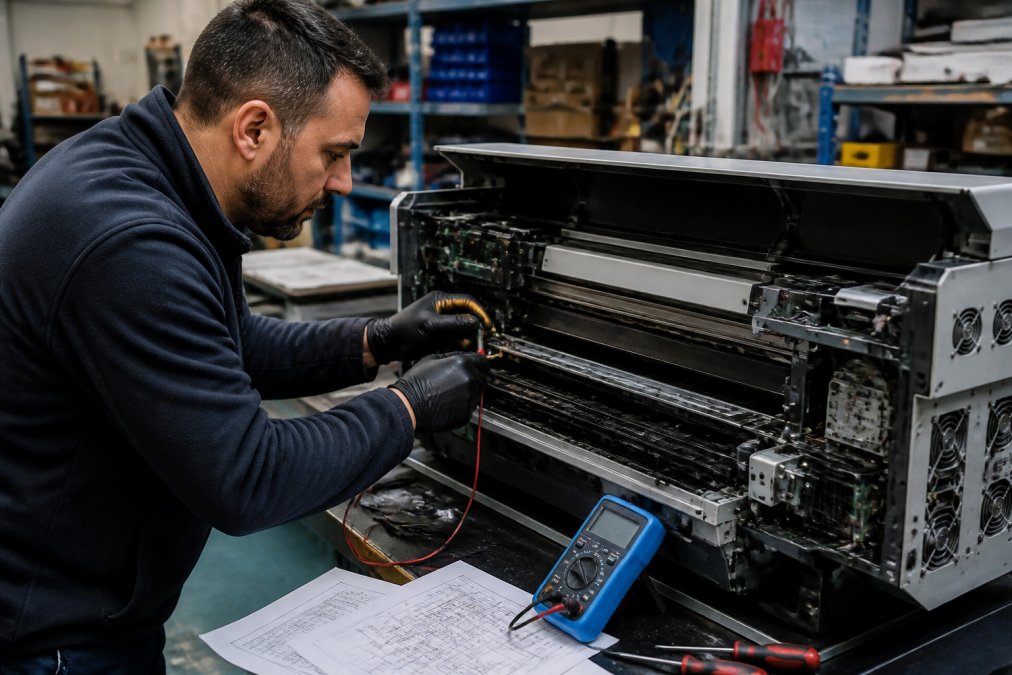
What separates us from generic repair shops is that we don't just fix the immediate problem, we investigate why it happened. We look at your maintenance history, your usage patterns, and your equipment setup. Then we give you recommendations to prevent it from happening again.
We're also transparent about costs and timelines. When you call, you get a straight answer about what we think the problem is, what it will cost to fix, and how long it will take. No surprises, no hidden charges.
Response Times and Service Flexibility
This is where most support relationships fail. A technician who arrives three weeks late isn't helpful, no matter how good they are.
Laserprints operates with response time commitments that reflect the urgency of production downtime. When you call with a breakdown, you're not waiting. Our team prioritises call-outs based on severity, and we dispatch engineers quickly. For many shops, this means someone arrives within 24-48 hours.
But response time is only part of the picture. Service flexibility matters just as much. Some shops need evening or weekend support because their production schedule doesn't fit standard business hours. We accommodate that. Some shops need remote support to solve problems instantly without waiting for an engineer. We offer that. Some shops need their equipment collected, repaired in our workshop, and returned, we do that too.
The key is having options. Not every situation requires an on-site engineer visit. Not every problem takes days to solve. A good support partner gives you choices based on what actually works for your operation, not what's easiest for them.
We also understand that you might have multiple pieces of equipment, and you need someone who can service all of it. Calling three different companies for three different machines is inefficient and expensive. We handle laser, DTF, and UV systems, which covers the core equipment most professional print shops run.
Getting Started with Reliable Support
If your current support arrangement isn't working, or if you're setting up a new operation and want to establish the right relationship from the start, the first step is straightforward: have a conversation.
Call Laserprints and describe your operation. Tell us what equipment you run, what's been problematic, and what you need from a support partner. We'll listen. We'll ask questions about your workflow, your production volume, and your pain points. Then we'll explain how we can help and what that looks like in practice.
Most shops find that having a reliable, specialised support partner actually reduces their costs. Instead of paying premium rates for emergency repairs, you're paying reasonable rates for preventative maintenance and quick fixes. Instead of losing weeks of production, you're back online in days.
We've worked with production managers who were frustrated with their previous support, operations teams managing multiple equipment types, and print shop owners who were tired of the stress of equipment failure. They all found that switching to specialised signage production support made a real difference.
The businesses that thrive aren't the ones that get lucky with equipment reliability. They're the ones that have built a support structure that prevents problems and responds quickly when something does go wrong.
If your current support arrangement is letting you down, or if you're looking to establish reliable support for the first time, Laserprints is ready to help. We specialise in laser machines, DTF printers, and UV print engines, the equipment that drives professional print operations. Our team provides expert diagnosis, rapid response, and quality repairs that keep your production running. Get started with Laserprints and eliminate the uncertainty around equipment downtime. Shop our support services and find the right option for your operation.
Frequently Asked Questions
Q: What makes signage production support from a specialist different from general repair services?
A: Specialists in signage production support understand the specific demands of laser, DTF, and UV printers used in high-volume commercial environments. They know the exact configurations, common failure points, and optimal maintenance schedules for these machines. General repair services often lack this depth and may misdiagnose issues or recommend unnecessary replacements. A specialist provider ensures your equipment receives expert care tailored to your production workflows, minimising downtime and extending machine life.
Q: How quickly can you typically respond to a breakdown in signage production equipment?
A: Response times depend on the service you choose. Our Call-Out Service (£125.00) brings a qualified engineer to your site to diagnose and repair faults on location. Remote Support (£24.99) provides immediate assistance for software and configuration issues via secure video link. For machines you can deliver to us, our In-House Repair Service (£100.00) includes full inspection and diagnosis. Most urgent issues receive attention within 24-48 hours, though we prioritise based on production impact.
Q: Can one service provider handle all my printing equipment, laser, DTF, and UV printers?
A: Yes. Many print shops operate mixed fleets with different engine types, and coordinating multiple vendors creates delays and higher costs. A specialist provider experienced across laser, DTF, and UV technologies can manage your entire equipment portfolio, provide consistent preventative maintenance schedules, and maintain a unified spare parts inventory. This simplifies operations, reduces communication overhead, and ensures standardised care across all your critical production assets.
Q: How do I know if preventative maintenance is worth the cost compared to reactive repairs?
A: Preventative maintenance helps to extend equipment life and keep machines running at peak performance. For businesses running high-volume production, consistent uptime and predictable costs are key.
This article was written using GrandRanker