

Table of Contents
- What Drives Industrial Laser Machine Repair Costs
- Laser Machine Downtime Costs: The Hidden Expense
- Typical Laser Cutter Repair Service Fees and Pricing Models
- Industrial Laser Maintenance Schedule: Prevention vs Emergency Repair
- Repair Options: In-House, Third-Party, and OEM Services
- How to Choose a Reliable Repair Service Provider
- Conclusion
- Frequently Asked Questions
Last Updated: September 3, 2026
What Drives Industrial Laser Machine Repair Costs
Industrial laser machine repair cost varies dramatically depending on what's actually broken. The difference between a software reset and a tube replacement isn't academic, it's the difference between a quick afternoon and weeks of production loss.

Several factors compound the total expense. Component type matters most: replacing a laser tube costs significantly more than repairing an electrical connector. Labour rates vary by technician experience and whether they're on-site or working in their workshop. Geographic location affects both travel time and hourly rates. Machine age and model complexity determine diagnostic difficulty and parts availability.
At Laserprints, businesses can be significantly impacted by repair bills that could have been avoided. The real cost driver isn't always the broken part itself, it's how long the machine sits idle while waiting for diagnosis, parts, or technician availability.
Travel time and callout fees add another layer. An engineer visiting your facility typically charges to arrive and assess the problem. That's before any actual repair work begins. If the diagnosis takes longer than expected, or if parts need ordering, those hours accumulate quickly.
Machine specifications matter too. A high-powered industrial CO2 laser requires different expertise than a fibre laser system. DTF and UV print engines have their own component hierarchies. A technician familiar with your specific equipment will diagnose and repair faster, and more accurately, than someone working outside their specialisation.
The hidden cost is downtime itself. Every hour your machine isn't producing represents lost revenue, delayed orders, and potentially unhappy clients. A business running five print engines can often absorb one being down for a day. Losing two simultaneously becomes an operational crisis.
Laser Machine Downtime Costs: The Hidden Expense
Downtime cost often exceeds the repair bill itself, yet many businesses don't calculate it. A production manager might focus on the repair charge and miss the lost orders during the days the machine was offline.
The calculation is straightforward: hourly production value multiplied by hours offline. A print shop producing work per hour loses for every eight-hour shift the machine sits idle. Over a week, that's in opportunity cost.
Indirect costs compound the problem. Rush orders to external service providers cost more. Clients who miss deadlines may take their business elsewhere. Staff sitting idle still draw wages. Rescheduling production creates inefficiencies across your entire workflow.
Emergency repairs cost more than planned maintenance. A technician arriving at short notice charges premium rates. Parts ordered urgently cost more than those ordered in advance. The pressure to get back online quickly often means accepting higher quotes without negotiating.
This is where preventive maintenance becomes financial strategy, not just operational housekeeping. A regular service schedule catches problems before they become emergencies. A worn component identified during routine inspection costs far less to replace than one that fails catastrophically mid-production.
Laserprints' remote support service addresses this by catching software issues before they cause downtime. For £24.99, remote diagnostics can resolve many problems without needing an engineer on-site, keeping your machine running and your revenue flowing. Shop now →

Typical Laser Cutter Repair Service Fees and Pricing Models
Understanding repair pricing structures helps you budget realistically and spot unreasonable quotes. Most service providers use one of three models: hourly labour rates, flat diagnostic fees, or fixed-price repairs for specific problems.
Hourly labour typically ranges per hour depending on technician experience and location. A straightforward repair might take two hours; a complex diagnosis could stretch to six. You're paying for expertise and availability, not just time.
Callout fees are separate from labour. Laserprints charges £125 for a breakdown and callout service, an engineer arrives at your facility, diagnoses the issue, and performs the repair if possible during that visit. This model works well for acute problems that need immediate attention. Shop now →

In-house repair services offer a different pricing structure. Laserprints' in-house service costs £100 and includes a full inspection, fault diagnosis, and repair work performed in the workshop. You package and deliver the machine, eliminating travel time and associated costs. This option suits situations where you can afford downtime in exchange for lower overall cost. Shop now →
Parts carry their own pricing. A replacement laser tube might cost depending on power and type. Control boards, mirrors, and lenses each have market rates. OEM parts cost more than third-party alternatives, but compatibility is guaranteed. Third-party parts are cheaper but may require adjustment or carry no warranty.
Some providers offer service contracts with fixed monthly fees covering regular maintenance and emergency callouts. These spread cost predictably across the year and typically cost less than paying per-incident, but only if you actually use the service.
The most expensive option is always the emergency repair without a service relationship. No existing relationship means no negotiating use, no priority scheduling, and no familiarity with your equipment. You'll pay list rates and wait longer.
Industrial Laser Maintenance Schedule: Prevention vs Emergency Repair
A structured maintenance schedule prevents most expensive repairs. Preventative work costs a fraction of emergency repairs because problems are caught early, before they cascade.
Monthly inspections catch loose connections, dust accumulation, and alignment drift. A technician spending time reviewing your system costs far less than a full diagnostic when something fails. These checks take place during normal operating hours and rarely cause downtime.
Quarterly deep cleaning removes dust and debris from optical components. Laser tubes perform better when their surroundings are clean. Mirrors stay aligned longer. Cooling systems work more efficiently. This maintenance extends component life by years.
Annual full servicing is the cornerstone of any maintenance programme. Laserprints recommends this for all professional-grade equipment. A technician performs complete inspection, cleaning, alignment checks, and any necessary adjustments. Annual servicing catches problems that would otherwise become emergency repairs.
The maintenance schedule depends on usage intensity. A machine running 40 hours per week needs more frequent attention than one running 10 hours. High-temperature applications like UV printing require more aggressive cooling system maintenance than CO2 laser systems.
Many businesses skip maintenance until something breaks, then complain about repair costs. This is financially backward. A maintenance contract prevents an emergency repair later. The maths is obvious once calculated.
Documentation matters too. Keep records of every service, every repair, every parts replacement. This history helps technicians understand your machine's condition and predict future problems. It also protects your warranty claims and resale value.
Repair Options: In-House, Third-Party, and OEM Services
You have three basic choices for where repairs happen: your own facility with an on-site technician, a third-party service provider's workshop, or the machine manufacturer's authorised service centre.
On-site repair means an engineer visits your facility, diagnoses the problem, and repairs it where the machine lives. Laserprints' callout service operates this way. The advantage is minimal downtime, the machine stays in production until the technician arrives, then goes back online immediately after repair. The disadvantage is cost: you're paying for travel time and technician premium rates for working in your environment. Shop now →
Third-party workshop repair means you transport the machine to the service provider's facility. Laserprints' in-house machine repair service works this model. You package and deliver the equipment, the technician performs full inspection and repair, and you collect it when ready. This costs less because the technician works in a controlled environment without travel time. The trade-off is downtime, your machine isn't producing while it's being serviced. For businesses with multiple machines, this is often acceptable. Shop now →
OEM authorised service centres carry the manufacturer's guarantee and have access to original parts and factory documentation. They're typically the most expensive option but the most reliable for warranty claims and complex problems. If your machine is under warranty, OEM service is often your only option.
Third-party specialists like Laserprints often match or beat OEM pricing because they work on multiple brands and have built efficiency through volume. They're not constrained by manufacturer protocols and can sometimes find creative solutions OEM technicians can't.
Remote support sits between these options. Laserprints' remote support service costs £24.99 and covers software issues, configuration problems, and troubleshooting that doesn't require physical intervention. Many problems, firmware updates, sensor calibration, workflow configuration, resolve without anyone touching the machine. This is the cheapest option when it works. Shop now →
Choose based on urgency and machine criticality. For emergency situations where production can't stop, on-site repair is worth the premium. For planned maintenance or non-critical machines, workshop repair saves money. For warranty protection, OEM service is essential.
How to Choose a Reliable Repair Service Provider
Finding a technician you can trust requires more than checking reviews. You need someone who understands your specific equipment, responds quickly, stands behind their work, and charges fairly.
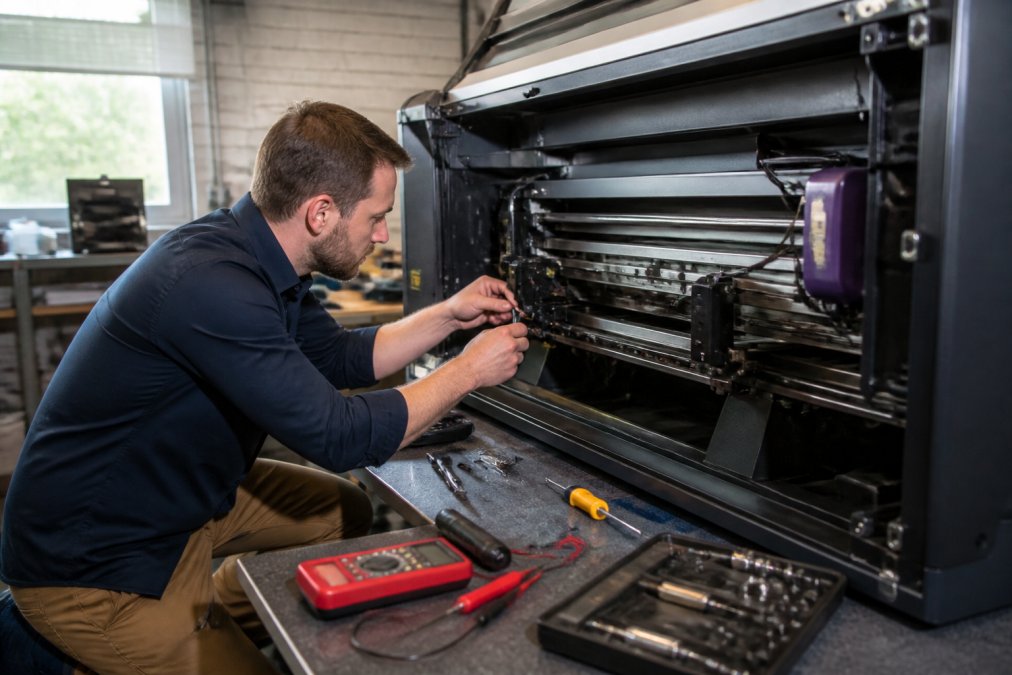
Ask whether the provider specialises in your machine type. A technician experienced with your specific brand and model will diagnose faster and more accurately than a generalist. They understand common failure patterns and know which parts fail first. This expertise translates directly into lower repair costs and better outcomes.
Check response time commitments in writing. "Quick response" means nothing. Does the provider guarantee same-day callout? Next-day? Do they have weekend availability? For production-critical equipment, response time is often more valuable than hourly rate. A technician arriving within a certain timeframe might cost more than one arriving later, but that difference is worth paying.
Verify they stock common spare parts. A technician who orders parts and returns later costs far more than one who carries inventory. Ask specifically about lead times for the parts your machine uses most often. If they don't stock your machine's common components, that's a warning sign.
Ask for references from businesses similar to yours. A provider experienced with high-volume print shops understands your constraints differently than one focused on hobbyist users. They know what "down for two hours" costs you and prioritise accordingly.
Understand their warranty on repairs. Do they guarantee their work for a specific period? What happens if the same problem recurs? A provider confident in their work stands behind repairs. One offering no warranty is shifting risk to you.
Laserprints provides this transparency: callout service includes diagnosis and repair during the visit when possible, with clear communication if parts need ordering. In-house service includes full inspection and fault diagnosis. Remote support resolves software issues without requiring on-site work. Each service has defined scope and expected outcomes.
Ask about preventative maintenance programmes. A provider offering regular service contracts has incentive to keep your machine healthy long-term. One only doing emergency repairs has incentive to keep you dependent on expensive callouts. The business model shapes their priorities.
Finally, get quotes in writing before work begins. A reputable provider outlines diagnostic cost, estimated repair cost, and parts cost separately. They explain what they found and why the repair costs what it does. Vague quotes from providers unwilling to explain their pricing are red flags.
Conclusion
Industrial laser machine repair cost depends on what's broken, where you are, and how quickly you need it fixed. A software issue might cost to diagnose remotely. A failed laser tube could cost and a week of downtime. The real expense isn't always the repair itself, it's the production loss while your machine sits idle.
Preventative maintenance shifts the economics entirely. Regular servicing catches problems before they become emergencies, extends component life, and keeps your equipment running predictably. For businesses with multiple machines or high production demands, planned maintenance is simply better economics than reactive repair.
Laserprints specialises in keeping your professional-grade laser, DTF, and UV print engines operational. Whether you need remote support to resolve a software issue, an on-site callout to diagnose an unexpected failure, or in-house repair with full inspection, our team delivers rapid response and transparent pricing. We understand that your equipment downtime is our problem, and we work to minimise it. Get started with Laserprints and keep your production running. Shop now →
Frequently Asked Questions
What is the average cost of industrial laser machine repair?
Industrial laser machine repair costs vary significantly depending on the fault and machine type. Call-out services typically start from £125, whilst in-house workshop repairs begin at £100. The final cost depends on parts required, labour time, and whether the repair is straightforward diagnostics or complex component replacement. Emergency repairs or those requiring specialist parts often cost considerably more than routine maintenance.
How often should an industrial laser maintenance schedule include professional servicing?
Most manufacturers recommend professional servicing every 6 to 12 months for machines in regular use, depending on daily operating hours and production volume. High-volume operations may benefit from quarterly inspections. Regular preventive maintenance catches wear before it causes costly downtime and extends machine lifespan. Neglecting scheduled maintenance often leads to unexpected failures that cost far more to repair than planned servicing would have cost.
Is preventive maintenance worth the cost compared to emergency repairs?
Yes. Preventative maintenance typically costs a fraction of emergency repair expenses. A single unplanned breakdown can cost hundreds or thousands in lost production, parts expediting, and emergency labour rates. Planned maintenance keeps machines operating reliably, reduces downtime, and prevents cascading failures that damage other components. For businesses relying on laser equipment for revenue, the investment in routine servicing pays for itself many times over.
How quickly can a repair service attend to a breakdown?
Response times vary by provider and location. Call-out services can often attend within 24 to 48 hours for urgent breakdowns, though remote support via video diagnosis may resolve issues faster for software-related faults. In-house workshop repairs require machine transportation but allow detailed fault investigation. When selecting a repair provider, confirm their typical turnaround time and whether they offer emergency call-out options, as speed directly impacts your production losses.
This article was written using GrandRanker