

Table of Contents
- What Professional Printer Maintenance Actually Costs
- Printer Maintenance Contract Cost: What You Pay For
- Industrial Printer Maintenance Costs by Machine Type
- The Cost of Printer Downtime Is Bigger Than the Invoice
- Building a Printer Maintenance Schedule That Fits Production
- DIY Servicing vs Professional Maintenance: Where the Money Goes
- How to Reduce Your Printer Maintenance Cost
- Conclusion
- Frequently Asked Questions
Last Updated: 18 October 2026
What Professional Printer Maintenance Actually Costs
The cost of professional printer maintenance in the UK typically splits into two very different budgets: reactive call-outs and planned servicing, and the cost of professional printer maintenance depends on which you lean on. We see production managers treat these as one line item, then get blindsided when a single breakdown lands a four-figure invoice mid-quarter. Understanding the split is the first step to controlling it.
A printer maintenance contract is a fixed or usage-based agreement covering scheduled servicing, parts allowances and priority response. A reactive call-out is a one-off charge for an engineer to attend a fault. The two are priced completely differently, and mixing them up is the most common budgeting mistake we encounter.
Reactive call-outs versus planned servicing
Reactive work is unpredictable by nature. You pay for diagnosis, travel and labour, and you pay again if parts are needed. Planned servicing spreads that exposure across the year and usually includes a defined response window.
Below is how the two compare on the factors that actually drive your budget:
| Factor | Reactive call-out | Planned servicing |
|---|---|---|
| Payment trigger | Fault occurs | Fixed schedule or usage |
| Cost predictability | Low | High |
| Response priority | Standard queue | Contracted window |
| Parts | Charged separately | Often included or discounted |
| Downtime exposure | Highest | Reduced |
Printer Maintenance Contract Cost: What You Pay For
Printer maintenance contract cost is driven by coverage scope, response time and machine value, not by a single headline rate. Contracts are usually priced as a fixed monthly fee, a per-page charge, or a hybrid of both. A per-page model suits high-volume production because the cost scales with actual use; a fixed fee suits predictable schedules.
What you are really buying is risk transfer. The contract absorbs the variance of breakdowns, parts and labour, and in return you pay a predictable amount. Whether that trade is worth it depends on how much unplanned downtime your operation can absorb.
Questions to ask before signing a contract
Before you commit, get clear answers on these points in writing:
- Which faults are excluded from cover?
- What is the guaranteed response time, and is it measured in hours or working days?
- Are consumables and printheads included or excluded?
- Is there a parts allowance, and what happens when it is exceeded?
- Does cover transfer if you add a machine to the fleet?
- What notice period applies if you want to exit?
Industrial Printer Maintenance Costs by Machine Type
Industrial printer maintenance costs vary sharply by engine type because the wear parts, servicing intervals and skill required differ. A laser engraving machine, a DTF printer and a UV print engine each fail in different ways, and each demands a different service approach.
- Laser machines: optics cleaning, alignment and extraction system checks dominate the service schedule.
- DTF printers: ink system health, printhead condition and daily maintenance routines drive cost.
- UV print engines: lamp or curing system checks, printhead care and substrate handling all affect servicing frequency.
The practical implication is that a single maintenance budget across a mixed fleet will always be wrong. Build the budget per machine type, then consolidate.
The Cost of Printer Downtime Is Bigger Than the Invoice
The cost of printer downtime usually exceeds the repair invoice itself. Lost production, missed delivery windows, idle staff and expedited reprints all stack up while a machine sits still. The invoice is the visible cost; the invisible cost is the reason maintenance budgets matter.
We advise production managers to calculate downtime cost per hour before negotiating any contract. Take your machine's hourly output value, multiply by the hours a typical fault takes to resolve, and add any penalty or expediting costs. That figure is the real benchmark against which a maintenance fee should be judged.
If a contract costs more per month than your calculated downtime exposure, it is overpriced. If it costs far less, you are probably under-covered on response time.
Building a Printer Maintenance Schedule That Fits Production
A printer maintenance schedule should be built around production windows, not around the engineer's convenience. The best schedules we see align servicing with known low-demand periods, so planned downtime lands when it costs least.
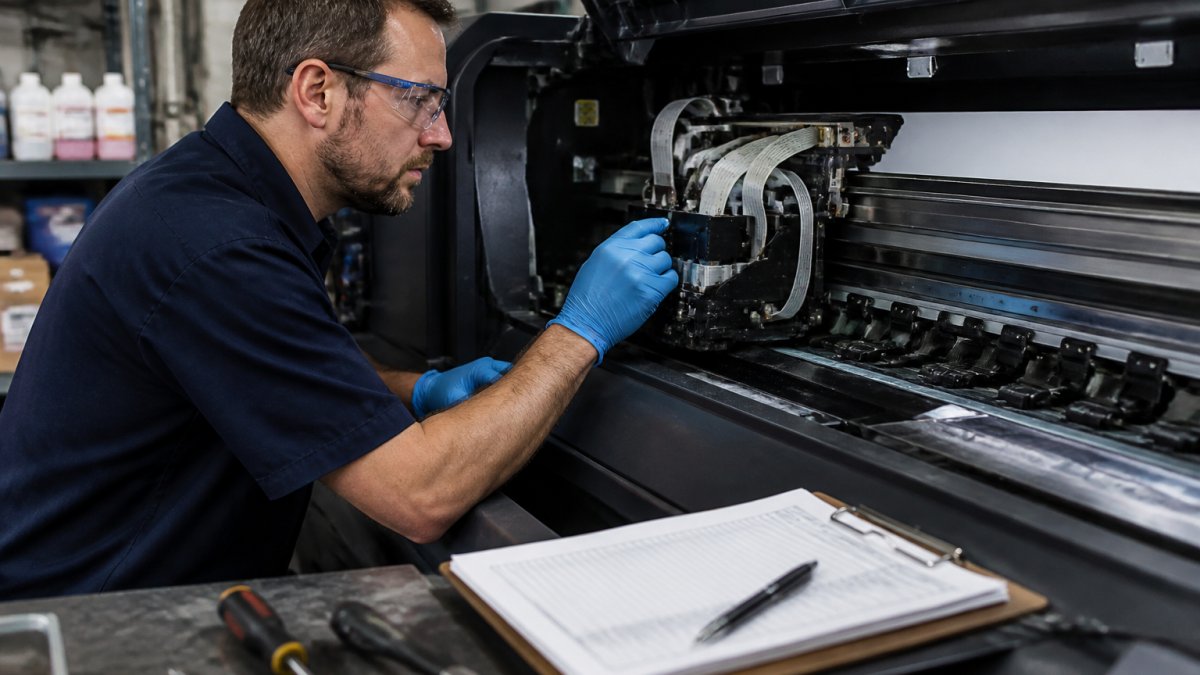
Start with the manufacturer's recommended service intervals, then adjust for your actual duty cycle. A machine running double shifts needs servicing more often than the manual assumes. Log every fault, however minor, because patterns reveal which components are wearing early.
Printer maintenance schedule components worth tracking:
- Daily: nozzle checks, ink levels, waste pad inspection
- Weekly: printhead cleaning cycles, filter checks, software updates
- Monthly: full calibration, belt tension, extraction system inspection
- Quarterly: comprehensive service, parts wear assessment, firmware review
DIY Servicing vs Professional Maintenance: Where the Money Goes
DIY servicing saves on labour but shifts risk onto your team. Routine tasks such as daily nozzle checks and external cleaning are genuinely safe to handle in-house. Anything involving printhead removal, ink system flushing or electrical diagnosis is where DIY attempts tend to cost more than they save.
The money question is not "can we do it cheaper?" but "can we afford the consequence if it goes wrong?" A misdiagnosed fault or a damaged printhead can turn a routine service into a major repair.
Where professional support pays for itself is in diagnosis and parts access. Our Remote Support Service at £24.99 resolves software, RIP configuration and workflow issues without a site visit, which is often the fastest route back to production. For hardware faults, our Call-Out Service at £125.00 sends a qualified engineer to diagnose and, where possible, repair on site. For machines that can be transported, our In-House Machine Repair Service at £100.00 avoids call-out charges entirely, with typical turnaround of two to three working days from delivery.


How to Reduce Your Printer Maintenance Cost
Reducing maintenance cost comes down to prevention, contract discipline and fast diagnosis. The cheapest repair is the one you never needed.
- Service on schedule, not on failure. Planned servicing catches wear before it becomes a breakdown.
- Train operators on daily checks. Most printhead problems start with a missed nozzle check.
- Use remote diagnosis first. Many faults are software or configuration issues resolvable without a site visit.
- Negotiate the contract around your actual usage. Do not pay for coverage your duty cycle does not need.
- Keep a fault log. Patterns let you challenge repeat failures and hold suppliers accountable.
Conclusion
The real challenge with printer maintenance is not the invoice, it is the unpredictability of when it lands. A mixed fleet of laser, DTF and UV machines makes that unpredictability worse, because each engine type fails differently and a single supplier rarely covers all three.
Laserprints specialises in exactly this problem. We handle laser machines, DTF and UV print engines, with expert repair and servicing, high-quality spare parts, and remote support that resolves many faults without a site visit. Our quick response times are built for production environments where every idle hour costs money.
Get started with Laserprints and keep your printing equipment running at peak performance. Shop now →
Frequently Asked Questions
How much does professional printer maintenance cost?
It depends on the service type. A reactive call-out starts at £125.00 for an engineer to attend site, diagnose the fault and repair where possible. Workshop repairs for DTF and UV printers are £100.00, printhead cleaning is £49.99, and remote software support is £24.99. Planned maintenance contracts are quoted per machine based on print volume, engine type and the number of visits you need each year, so ask for a written breakdown before you commit.
Is a printer maintenance contract worth the cost?
A contract pays for itself when unplanned stoppages cost more than the visits. Add up your lost production for a single day of downtime, then compare it with the annual contract price. Contracts also fix your servicing dates in advance, which keeps your printer maintenance schedule predictable and stops small faults becoming printhead or ink system failures. If your machines run high volumes, the maths usually favours a contract. Low-volume shops may do better on call-out plus remote support.
How often should an industrial printer be professionally serviced?
Most production machines need a professional service every three to six months, with weekly operator checks in between. High-volume DTF and UV engines running daily shifts often need quarterly visits, while laser machines on lighter duty can stretch to twice a year. Build your printer maintenance schedule around print volume and ink throughput rather than the calendar alone, and book the next visit before the current one ends so you are not waiting in a queue when something fails.
Can we cut costs by fixing faults ourselves?
Some tasks are safe to handle in-house: daily nozzle checks, cleaning wiper blades, topping up fluids and keeping the machine environment clean. Beyond that, DIY repairs often cost more than they save. A misdiagnosed printhead fault can turn a £49.99 cleaning into a full replacement, and incorrect handling of ink systems can void warranties. Use remote support at £24.99 to get a qualified engineer's view before anyone reaches for a toolkit.