

Table of Contents
- Why Genuine DTF Parts Matter for Your Production Line
- Visual Checks: How to Verify Authentic DTF Printheads and Components
- DTF Printer Maintenance Best Practices That Protect Your Investment
- The Risks of Using Aftermarket DTF Parts in High-Volume Production
- How to Source Reliable DTF Printer Parts from Trusted Suppliers
- Your Verification Checklist Before Fitting Any Spare Part
- Frequently Asked Questions
Last Updated: September 10, 2026
Why Genuine DTF Parts Matter for Your Production Line
A counterfeit printhead rarely fails on day one. It fails on day ninety, mid-run, with a client deadline attached. Learning how to identify genuine DTF printer spare parts is the cheapest insurance a production manager can buy.
Genuine components are manufactured to the printer maker's tolerance for nozzle geometry, ink channel materials and electrical resistance. Counterfeit and grey-market parts are reverse-engineered to a price, not a specification. The result is drift: colour shifts, banding, premature nozzle dropout and, in the worst cases, ink contamination that damages the mainboard and turns a £200 part into a £2,000 repair.
The financial case is straightforward. A failed production run costs you film, ink, powder and labour, then costs you again when the customer moves the next order elsewhere. Genuine parts protect the whole chain.
Visual Checks: How to Verify Authentic DTF Printheads and Components
Start with the physical evidence before the part ever touches the machine. Genuine DTF printheads and components carry consistent, high-resolution markings, while counterfeits typically show blurred print, missing batch codes or mismatched fonts across the same box.
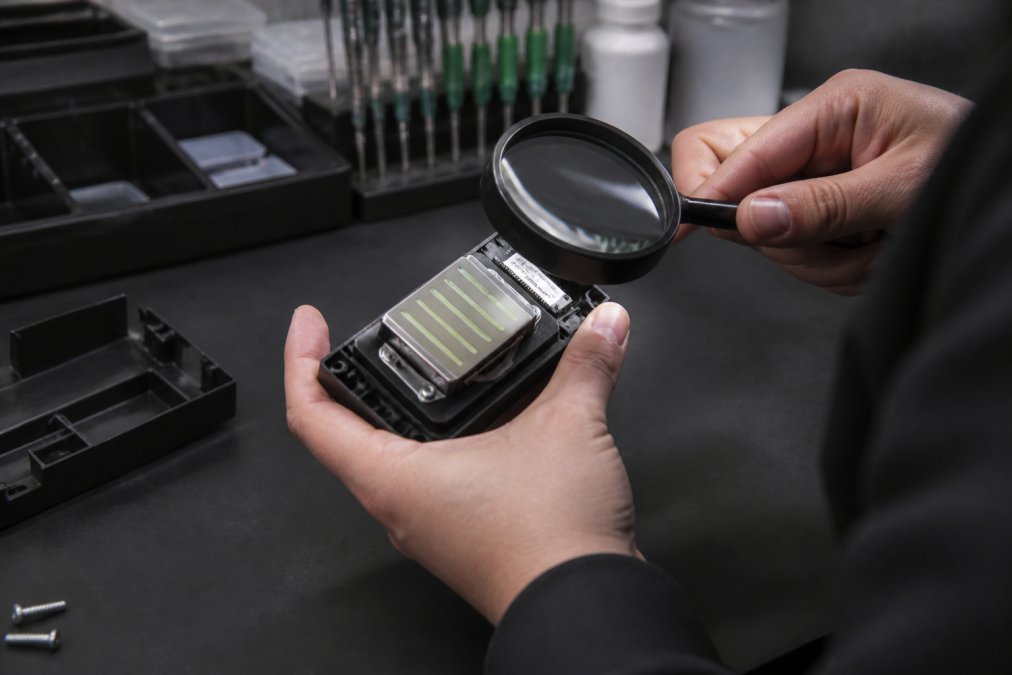
Checking Holograms, Serial Numbers and Packaging
Genuine packaging uses a holographic security label that shifts colour under angled light and cannot be photocopied cleanly. The serial number on the box must match the serial etched or labelled on the printhead itself. If those two numbers disagree, stop. That mismatch is the single most reliable counterfeit signal we see.
Look for tamper-evident seals that are intact and undamaged. Re-sealed boxes with wrinkled tape or a missing inner bag usually mean a genuine shell has been fitted with a non-genuine part.
Examining Build Quality and Nozzle Plate Markings
Run your eye along the nozzle plate under a bright lamp. Genuine plates are machined flat with crisp, uniform nozzle rows and a laser-etched part code. Counterfeits show tooling marks, uneven nozzle spacing or a plate that sits proud of its housing.
Check the connector block too. Genuine ribbon connectors seat with a positive click and use consistent plating colour. Cheap copies often have thinner pins that deform on first insertion.
| Check | Genuine Part | Counterfeit Sign |
|---|---|---|
| Hologram | Shifts colour at angle | Flat, photocopied look |
| Serial number | Box matches part | Mismatched or missing |
| Nozzle plate | Flat, crisp etching | Tooling marks, uneven rows |
| Connector pins | Positive click, even plating | Deformed, thin pins |
| Packaging seal | Intact, tamper-evident | Re-taped or wrinkled |
DTF Printer Maintenance Best Practices That Protect Your Investment
DTF printer maintenance best practices are simple, repetitive and boring, which is exactly why they get skipped. Daily nozzle checks, a weekly clean of the capping station and wiper blade, and correct ink storage do more to extend printhead life than any single upgrade.
Keep a log. Record nozzle check results, cleaning cycles and ink batch numbers against the machine's running hours. When a fault appears, the log tells you whether it is a maintenance gap or a failing part, and that distinction decides whether you clean or replace.
Never let a machine sit idle with ink in the head for extended periods without a maintenance cycle. Dried ink in the channels is the most common cause of a head that cannot be recovered.
The Risks of Using Aftermarket DTF Parts in High-Volume Production
The risks of using aftermarket DTF parts scale with volume. A hobbyist printing twenty shirts a week may never notice a slightly off-spec damper. A production line running continuously will find every weakness, usually within the first few thousand prints.
The failure modes cluster in three areas:
- Colour drift. Non-genuine nozzles eject inconsistent droplet volumes, so your ICC profile stops matching output.
- Electrical damage. Out-of-tolerance resistance in a cheap head can stress the mainboard, turning a small saving into a full board replacement.
- Warranty loss. Manufacturers routinely decline claims where a non-genuine part is implicated, and proving otherwise is difficult.
There is also a hidden labour cost. Recalibrating, re-profiling and reprinting failed jobs consumes technician hours that never appear on the parts invoice.
How to Source Reliable DTF Printer Parts from Trusted Suppliers
Learning how to source reliable DTF printer parts comes down to three questions: can the supplier name the part's origin, can they provide a traceable serial, and will they stand behind it if it fails?
Authorised distributors and specialist repair houses answer all three. Marketplace listings with stock photography and no part number usually answer none. Ask for the batch code before you order, and ask what happens if the part is faulty on arrival.
At Laserprints, our engineers fit and support the same components we sell, including the I3200 Printhead, the I1600 Printhead, the L1800 Printhead and the XP600 Printhead. Because we also repair the machines these parts go into, we see which components survive production conditions and which do not.


For guidance on equipment safety and correct handling of electrical components, the Health and Safety Executive guidance on electrical safety is a sensible reference point for any workshop.
Your Verification Checklist Before Fitting Any Spare Part
Work through this before the part goes anywhere near the machine. It takes five minutes and prevents most of the failures we are called out to fix.
- Box hologram shifts colour when tilted
- Serial number on the box matches the part
- Tamper seals intact, no re-taping
- Nozzle plate flat with crisp etched code
- Connector pins straight, even plating, positive click
- Batch code recorded in your maintenance log
- Supplier confirmed returns policy for faulty parts
- Nozzle check run and photographed after fitting
If any box is unticked, stop and query it with the supplier before fitting. A part that fails the checklist will almost certainly fail in production.
Frequently Asked Questions
Why is it important to use genuine DTF printer parts?
Genuine DTF parts are manufactured to the printer maker's exact tolerances, so they fit correctly, deliver consistent ink flow and maintain print quality across long production runs. Counterfeit or low-grade alternatives often have misaligned nozzles, inferior seals and incorrect electrical resistance, which can cause banding, clogging and premature printhead failure. Using genuine components also protects your warranty and avoids the knock-on costs of reprints, wasted film and unplanned downtime. For production managers running high-volume DTF lines, the price difference between a genuine printhead and a cheap copy is almost always smaller than the cost of a single failed job.
How can I spot counterfeit DTF printheads?
Counterfeit printheads usually give themselves away through packaging and finish. Look for misspelled branding, flimsy cardboard, missing holographic seals and serial numbers that do not match the manufacturer's format. On the unit itself, check the nozzle plate for uneven etching, rough edges or a loose ribbon cable connector. Genuine printheads such as the I3200-A1 or XP600 have crisp laser-etched markings and consistent weight. If the price is dramatically lower than your usual supplier and the item ships without a proper invoice or traceable batch code, treat it as suspect and verify before fitting it to your machine.
Do non-genuine spare parts void my printer warranty?
In most cases, yes. Printer manufacturers specify that warranty coverage applies only when genuine or approved parts are fitted by qualified technicians. Fitting an aftermarket printhead, capping station or mainboard can void the warranty on the affected assembly and sometimes on the whole machine. If a non-genuine part causes damage to other components, such as ink leaking onto the mainboard, the repair bill falls on you. Before fitting any third-party component, check the terms of your warranty and confirm with your supplier whether the part is approved for your specific printer model.
How do I verify a supplier of DTF printer parts?
Start by checking that the supplier trades from a registered business address and can provide a VAT invoice. Ask for the manufacturer part number and batch code before ordering, and confirm they match the component you need. A reputable supplier will answer technical questions about compatibility, offer a returns policy and provide traceability on every order. Look for evidence they support production environments, such as documented turnaround times and access to qualified technicians. If a supplier cannot explain where a printhead came from or refuses to put a warranty in writing, source your parts elsewhere.
Counterfeit parts are the quiet cause of most "unexplainable" DTF downtime, and the fix starts with buying from a supplier who understands the machines. Laserprints specialises in laser, DTF and UV print engines, providing expert repair and servicing, genuine spare parts and remote support with quick response times. Get started with Laserprints and keep your production line running.