

Table of Contents
- The Real Appeal of Used Industrial Printer Parts
- Pros and Cons of Buying Used Industrial Printer Parts
- Refurbished Industrial Printer Parts: A Middle Ground Worth Considering
- Risks of Non-OEM Printer Components You Should Know
- Printer Component Failure Signs That Tell You to Act Now
- How to Evaluate a Used Part Before You Commit
- Alternatives: New Parts, Refurbished Stock, and Expert Repair
- Conclusion
Last Updated: 26 August 2026
The Real Appeal of Used Industrial Printer Parts
Production downtime is expensive. Every hour a laser machine, DTF printer, or UV print engine sits idle translates directly into missed orders, strained client relationships, and mounting pressure on production managers to find a fix, fast. That urgency is precisely why used industrial printer parts attract serious attention from operations teams across manufacturing and print service businesses.
At Laserprints, we see this calculation play out regularly. A used component can cost significantly less than its new equivalent, and when a machine is down, speed and cost both matter enormously. Used parts are often available immediately through secondary markets, whereas new OEM components sometimes carry lead times incompatible with a live production schedule.
But the decision is more nuanced than it first appears. Used industrial printer parts vary enormously in condition, provenance, and remaining service life. A part pulled from a decommissioned machine that ran for three years under heavy production load is fundamentally different from one removed after six months of light use. The price tag rarely tells you which you're getting.
Below, we'll work through the real pros and cons, the risks specific to non-OEM components, the warning signs that demand immediate action, and how to evaluate a used part before committing. The goal is to give you a clear-eyed framework for making this decision.
Pros and Cons of Buying Used Industrial Printer Parts
Used industrial printer parts are neither universally sensible nor universally reckless. The answer depends on which component you need, where you source it, and how critical that component is to your print quality and uptime.
| Factor | Potential Advantage | Potential Risk |
|---|---|---|
| Cost | Substantially lower than new OEM | Hidden damage not reflected in price |
| Availability | Often faster from secondary markets | No guarantee of stock or condition |
| Compatibility | Same part number = confirmed fit | Counterfeit or misrepresented specs |
| Warranty | Occasionally offered by reputable sellers | Most sold as-is, no recourse |
| Remaining life | Unknown without testing | Could fail shortly after installation |
| Environmental impact | Reduces waste, extends part lifecycle | Contaminated components can damage other assemblies |
Where the Savings Are Real
For certain categories of component, buying used makes clear operational sense. Mechanical parts with low wear characteristics, chassis components, guide rails, paper feed assemblies, and certain motor assemblies, often retain full functionality long after a machine is retired. If the machine was decommissioned for reasons unrelated to these components, the mechanical parts may have substantial remaining life.
Older model machines present another strong case. When a specific laser or UV print engine reaches end-of-life status with the OEM, new parts simply stop being manufactured. For businesses running legacy equipment that still performs well, a quality used part can extend machine life by years.
The savings are also meaningful when the component is straightforward to test on arrival. A motor that either runs or doesn't, a fan assembly that spins freely, a belt that shows no cracking, these are components where condition is reasonably easy to verify before committing the part to service.
Where the Risks Outweigh the Price
Print heads are the clearest example of where used rarely makes sense. A used print head may appear functional during basic testing but carry partial nozzle blockages, degraded piezo elements, or contamination that only manifests under sustained production load. The cost of a failed print head includes misprints, wasted substrate, and downtime while sourcing a replacement.
High-voltage components in laser print engines carry similar caution. Drum units, fuser assemblies, and laser scanning units degrade in ways that aren't always visible on inspection. A fuser approaching the end of its service life simply delays the next failure.
Electronic control boards represent a third category where used purchases carry disproportionate risk. Boards can carry latent faults from power surges that don't surface immediately but cause intermittent errors under load.
Refurbished Industrial Printer Parts: A Middle Ground Worth Considering
Refurbished industrial printer parts occupy a distinct category that many buyers conflate with simply "used." The distinction matters.
A refurbished part has been inspected, tested, and restored to a defined performance standard by a specialist. Worn elements are replaced, contamination is removed, and the component is verified against manufacturer specifications before resale. A used part is typically sold in whatever condition it was removed, with no intervention and minimal verification.
For components where condition is difficult to assess visually, print heads, fuser assemblies, electronic boards, refurbished stock offers meaningful risk reduction. Many reputable suppliers provide a limited warranty, which used parts almost never carry. That warranty signals the supplier's confidence in the component.
The cost premium over used parts is real, but it's worth framing correctly. The relevant comparison is refurbished versus used plus the probability-weighted cost of failure. As documented in guidance on total cost of ownership for industrial equipment, the true cost of a component includes installation, testing, and the downstream cost of failure, not just the purchase price.
Refurbished parts also tend to come with cleaner provenance. A specialist refurbisher can often confirm the part's origin, the hours it logged, and what work was carried out.
Risks of Non-OEM Printer Components You Should Know
The risks of non-OEM printer components extend well beyond print quality. Non-OEM components, whether new aftermarket or used, are manufactured to tolerances that may differ from the original specification. A small dimensional variance or different material composition might seem inconsequential but can affect performance under sustained production load.
The most immediate risk is compatibility. A component that fits physically may not perform identically to the OEM part. Ink flow characteristics, thermal behaviour, and electrical draw can all differ in ways that affect surrounding assemblies. A non-OEM fuser running hotter than specification accelerates wear on adjacent components.
There's also a warranty consideration that many businesses overlook. Fitting non-OEM components can void the manufacturer's warranty on the machine itself and affect service agreement terms. As noted in UK consumer and commercial warranty guidance, warranty terms around third-party parts vary significantly and should be reviewed before any non-OEM component is installed.
For UV print engines specifically, non-OEM lamp assemblies and curing components carry an additional risk: inconsistent UV output. A lamp delivering lower or uneven UV intensity produces under-cured prints that appear acceptable but fail adhesion testing after delivery.
The bottom line on non-OEM components: they're not categorically unsuitable, but they require more rigorous verification than OEM parts, and the risks compound when they're also used rather than new.
Printer Component Failure Signs That Tell You to Act Now
Most industrial printer failures don't arrive without warning. Early failure signs are easy to dismiss as minor inconsistencies until they become a full production stoppage.
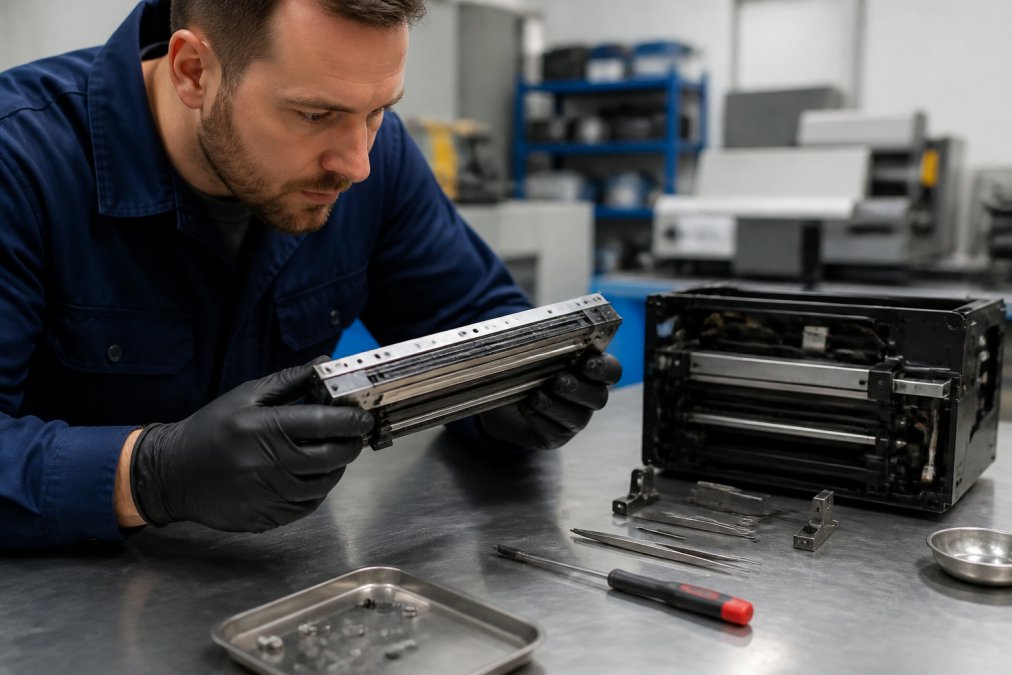
Recognising early failure signs is the difference between planned maintenance and emergency repair. The most common early indicators across laser, DTF, and UV print engines include:
- Banding or streaking in output: Consistent horizontal or vertical lines typically indicate a failing print head, worn drum unit, or degraded laser scanning assembly.
- Inconsistent colour density: Output varying in saturation across a print run points to ink delivery issues, a failing pump, or print head degradation.
- Unusual mechanical noise: Grinding, clicking, or irregular motor sounds typically indicate bearing wear, misaligned drive assembly, or debris in a mechanical pathway.
- Elevated error codes: A code that clears on restart but recurs signals a component's condition, not a software glitch.
- Increased warm-up times: A UV lamp or fuser assembly taking longer than usual to reach operating temperature indicates degradation.
- Ink or toner leakage: Any leakage outside normal ink pathways indicates a seal failure or cracked component that will worsen under continued use.
These signs rarely appear in isolation. A failing fuser often produces both banding and elevated error codes simultaneously. When two or more indicators appear together, urgency increases significantly.
Acting on early failure signs typically means a single component replacement. Ignoring them often means a cascade failure that takes out adjacent assemblies.
How to Evaluate a Used Part Before You Commit
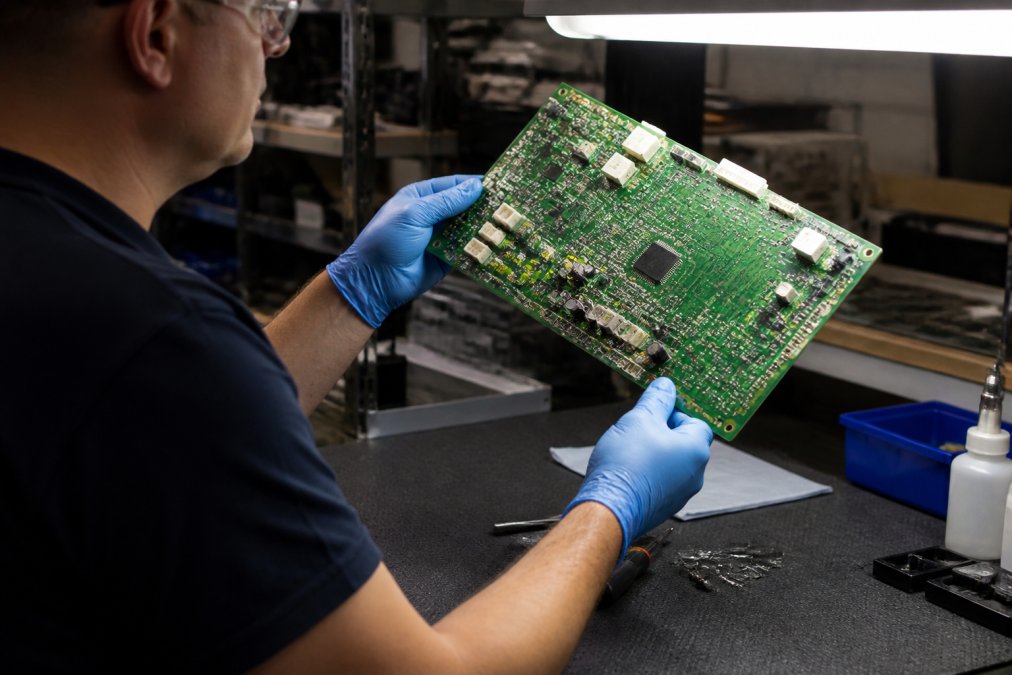
Evaluating a used part properly requires more than visual inspection, though that's where the process starts. A structured approach reduces the risk of fitting a component that fails prematurely or causes secondary damage.
Seller Reputation and Traceability
The seller matters as much as the part. A used component sold by a specialist with documented provenance is fundamentally different from one listed without any history on a general resale platform.
Prioritise sellers who can confirm:
- The machine the part was removed from (make, model, age)
- The reason for removal (machine decommissioned, upgraded, or failed for a different reason)
- The approximate hours or volume the component has logged
- Whether any testing was carried out after removal
Reputable specialist suppliers will also offer some form of returns policy, even on used stock. The absence of any recourse should be treated as a significant risk signal. According to guidance on commercial purchasing rights and seller obligations, business-to-business purchases carry implied terms around fitness for purpose under the Sale of Goods Act 1979, but enforcing those terms against an unknown seller is rarely practical, so verification upfront is essential.
What to Inspect on Arrival
Visual inspection on arrival should be methodical. For any used component:
- Check for physical damage: Cracks, chips, corrosion, and burn marks are disqualifying.
- Inspect connectors and contacts: Oxidised or bent contacts cause intermittent faults difficult to diagnose once installed.
- Check seals and gaskets: On ink-path components, deteriorated seals will leak under pressure.
- Verify part numbers: Confirm the part number matches your machine's specification exactly.
- Test before committing to production: Install the component and run a test cycle before returning the machine to full production load.
A common mistake is skipping the test cycle because the machine is needed urgently. A component that fails under production load causes more disruption than a brief test delay.
Alternatives: New Parts, Refurbished Stock, and Expert Repair
Used parts are one option in a broader decision framework. Understanding the full range helps production managers make the right call for each situation rather than defaulting to the cheapest option.
New OEM parts remain the benchmark for critical components. They carry manufacturer specifications, defined service life, and typically come with warranty coverage. The cost premium is real, but so is the risk reduction, particularly for print heads, fuser assemblies, and electronic control boards. Lead times can be a constraint, which is why maintaining a small inventory of high-failure-rate components is standard practice in well-run print operations.
Refurbished parts from specialist suppliers offer a middle path: lower cost than new OEM, higher confidence than used. For components where refurbishment is technically meaningful, print heads, laser scanning units, fuser assemblies, this is often the most pragmatic choice.
Expert repair services address a dimension that part replacement doesn't: the underlying cause. A machine that keeps failing in the same way isn't a parts problem, it's a diagnostic problem. Professional repair identifies root causes and often prevents the next failure. As outlined in British Printing Industries Federation guidance on equipment maintenance, planned maintenance and expert servicing consistently deliver lower total cost of ownership than reactive repair.
The Laserprints team works across laser machines, DTF printers, and UV print engines, providing repair, servicing, and spare parts from a single point of contact. For businesses managing multiple print technologies, that breadth eliminates the coordination overhead of managing separate specialist relationships.
The honest answer on alternatives is this: the right choice depends on the component, the machine's age, your production schedule, and your risk tolerance. A structured decision, rather than a reflexive reach for the cheapest option, is what protects uptime over the long term.
Frequently Asked Questions
Q: What are the risks of using refurbished parts in industrial printers?
A: Refurbished parts vary considerably in quality depending on who reconditioned them and how. The main risks are hidden wear that shortens the part's working life, incompatibility with your specific machine model, and the potential to affect any remaining manufacturer warranty. Buying from a specialist who tests and guarantees refurbished components can help reduce these risks. Always ask for documentation of the reconditioning process and confirm whether a warranty is included before purchasing used industrial printer parts.
Q: Which industrial printer components are safe to buy used?
A: Low-wear mechanical parts, such as covers, frames, trays, and certain rollers, are generally lower risk when bought used, provided they show no visible damage or corrosion. High-precision or high-wear components, including print heads, laser units, UV lamps, and fuser assemblies, carry far greater risk second-hand. These parts degrade with use in ways that are not always visible on inspection, and a failing component of this type can damage surrounding parts, making the cost saving short-lived.
Q: Do used printer parts affect the manufacturer's warranty?
A: Yes, fitting non-OEM or used parts can affect a manufacturer's warranty, depending on the terms. Under the Consumer Rights Act 2015, your statutory rights relate to the goods as sold, but manufacturer warranties are separate contractual documents with their own conditions. Most OEM warranties specify that only approved parts should be fitted. If your machine is still under warranty, check the terms carefully before sourcing used industrial printer parts, or consult a qualified service provider who can advise on compliant options.
Q: How can I verify the quality of second-hand printer components?
A: Request the part's service history and, where possible, its original manufacture date. Ask the seller whether the component has been tested and under what conditions. Inspect for physical wear, corrosion, or burn marks on arrival. For precision parts such as print heads or laser assemblies, visual inspection alone is rarely enough, a specialist technician should bench-test the component before installation. Buying from a reputable UK-based supplier with clear returns and warranty terms is a reliable safeguard.
Keeping industrial printing equipment running under production pressure is a constant challenge. Laserprints supports UK manufacturers and print service providers with expert repair, high-quality spare parts, and rapid response times across laser, DTF, and UV print engines. Whether you need a specific component, a diagnostic assessment, or an ongoing maintenance partnership, our team is ready to help. Shop now →
This article was written using GrandRanker