

Table of Contents
- Why Industrial Printers Fail Without Regular Care
- Signs of Industrial Printer Wear and Tear
- The Cost of Neglect: What Happens When Maintenance Is Skipped
- Benefits of Professional Industrial Printer Repair Services
- Industrial Printer Maintenance Schedule: What You Need to Know
- Common Failure Points in Laser, DTF, and UV Print Engines
- Taking Action: Your Next Steps
- Frequently Asked Questions
Last Updated: September 25, 2026
Why Industrial Printers Fail Without Regular Care
Industrial printers are built to perform under demanding conditions, but they're not invincible. When maintenance is neglected, these machines don't simply slow down, they fail in ways that halt production, damage components, and create expensive repair bills. The reason why industrial printers fail without regular care comes down to how these systems work: ink circulates through printheads, mechanical parts move thousands of times per shift, and thermal stress builds with every print cycle. Without preventive care, blockages accumulate, seals degrade, and electrical connections corrode. Small problems ignored often become catastrophic failures.
The cost of learning this lesson the hard way is steep. A printhead that could have been cleaned for under £50 becomes a £500+ replacement. A laser tube that needed coolant checks fails mid-production run, costing days of downtime. The difference between a thriving print operation and one struggling with constant breakdowns often comes down to one thing: whether maintenance happens on a schedule or only when something breaks.

Signs of Industrial Printer Wear and Tear
Spotting wear early is the key to preventing failures. The first warning signs are often subtle: print quality drifts before it becomes obviously bad, speeds drop slightly, or you notice inconsistent colour across jobs. These aren't just cosmetic issues, they're signals that components are degrading.
Common visible indicators include nozzle mist or ink spray patterns that aren't crisp, colour banding where ink isn't flowing evenly across the printhead, and temperature readings that fluctuate more than usual. On DTF machines, you might see ink settling in the lines or viscosity changes that affect flow. UV printers show their stress through uneven curing or spots where the light intensity drops. Laser machines often signal trouble through power inconsistency, the beam fires at full strength on one pass and weaker on the next.
Listen to the machine as well. Unusual grinding sounds, squealing from belts, or clicking noises from stepper motors all indicate mechanical wear. If your operator has started mentioning that "something sounds different," that's a maintenance call waiting to happen.
The critical insight here is timing: catching these signs means you can schedule maintenance during a slow production period, not during a rush job. Waiting until the machine stops working entirely means emergency repairs, rushed diagnostics, and lost orders.
The Cost of Neglect: What Happens When Maintenance Is Skipped
Neglecting maintenance creates a cascade of failures. When a printhead isn't cleaned regularly, ink residue hardens inside the nozzles. What started as a partial blockage becomes a complete one. The machine tries to force ink through, pressure builds, and internal channels flood. At that point, cleaning won't recover the printhead, replacement is the only option.
Thermal stress compounds the damage. Printheads, UV lamps, and laser tubes all generate heat. Without proper cooling, seals crack and components warp. A thermal failure in a printhead isn't repairable; it's a replacement scenario. The same applies to UV lamps, overheating shortens their lifespan dramatically, and they can fail suddenly mid-production.
Mechanical wear accelerates without lubrication and alignment checks. Belts stretch, bearings degrade, and stepper motors lose precision. A misaligned carriage that drifts by 0.5mm might seem minor, but it compounds across a production run, creating visible defects. Fixing misalignment requires disassembly and recalibration, work that takes time and expertise.
The financial impact extends beyond parts. Every hour a machine is down costs money in lost production, rushed overtime to catch up, and customer relationships strained by missed deadlines. Unplanned downtime can lead to significant financial losses, with some businesses estimating thousands in lost orders, far exceeding the cost of preventive maintenance.
Benefits of Professional Industrial Printer Repair Services
Bringing in professional repair services changes the trajectory of equipment performance. A qualified engineer doesn't just fix what's broken, they identify what's about to fail and prevent it before it happens. This is the core benefit of professional servicing: it moves you from reactive repairs to proactive maintenance.
Professional services provide diagnostic depth that in-house attempts often lack. Engineers have seen dozens of machines and know the failure patterns. They can spot a failing capacitor before it fails, recognise the early signs of a thermal issue, or identify ink contamination before it damages the printhead. This pattern recognition saves time and prevents costly mistakes.
The range of services matters too. Laserprints offers printhead cleaning services that use specialist techniques to recover blocked nozzles, extending printhead life significantly. For machines that need workshop-level diagnosis, in-house machine repair services provide comprehensive assessment and repair with turnaround times of 2-3 working days. When you need quick answers without waiting for an engineer visit, remote support services connect you with an engineer via secure video and remote desktop access to troubleshoot software and configuration issues.

For breakdown situations, call-out services dispatch an engineer to your site to diagnose faults and repair on-site where possible, or determine what workshop-level work is needed. This tiered approach means you're not paying for an engineer visit when a remote session would solve the problem, and you're not waiting days for a workshop repair when on-site diagnosis can happen quickly.
The trust factor matters as well. When you work with a dedicated service provider, they can gain a deeper understanding of your equipment, workflow, and priorities, helping to identify what's normal for your operation versus what's a warning sign.
Industrial Printer Maintenance Schedule: What You Need to Know
A proper maintenance schedule prevents most failures. The frequency depends on usage, but the principle is consistent: routine checks catch problems early, and deeper servicing prevents wear from accumulating.
Daily checks take minutes: verify ink levels, check for obvious leaks, and run a test print to confirm quality. Weekly, run a more thorough nozzle check and clean any external surfaces where dust has accumulated. Monthly, check coolant levels on laser machines, inspect belts for fraying, and verify that all moving parts are operating smoothly.
Quarterly servicing should include professional inspection. This is where an engineer checks alignment, tests electrical connections, verifies thermal performance, and assesses component wear. Quarterly intervals catch problems before they become emergencies.
Annual deep servicing involves complete system checks, calibration, and replacement of wear items like seals and filters. This is the investment that keeps equipment reliable for years.
| Maintenance Task | Frequency | Impact | Who Performs |
|---|---|---|---|
| Nozzle checks and test prints | Daily | Catches quality issues early | Operator |
| Ink and coolant level checks | Weekly | Prevents starvation failures | Operator |
| Belt and seal inspection | Monthly | Identifies wear before failure | Operator or technician |
| Professional diagnostic check | Quarterly | Prevents emergency breakdowns | Professional engineer |
| Deep system servicing | Annually | Extends equipment lifespan | Professional engineer |
The mistake many operations make is skipping the quarterly checks. They run fine until they don't, and then an unexpected failure becomes a crisis. Building maintenance into your production schedule, treating it as a non-negotiable cost of operation, transforms equipment reliability.
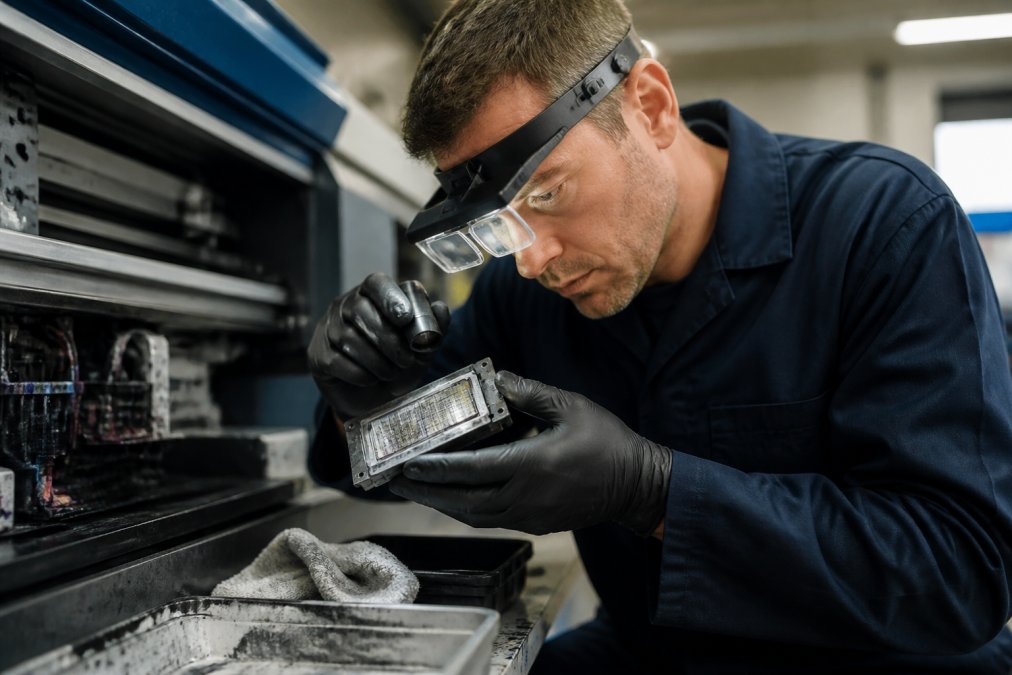
Common Failure Points in Laser, DTF, and UV Print Engines
Different print technologies fail in different ways. Understanding the weak points in your specific equipment helps you focus maintenance efforts where they matter most.
Laser machines fail most often at the tube and cooling system. The laser tube generates intense heat, and if coolant flow drops, through blockages, leaks, or pump failure, the tube overheats and its output degrades. A failing tube can't be repaired; it's a £1,000+ replacement. Mirrors and lenses also degrade when dust accumulates, scattering the beam and reducing cutting or engraving precision. The power supply is another stress point; electrical components fail if the machine isn't properly earthed or if voltage spikes occur.
DTF printers fail at the printhead and ink system. The DTF process uses thick, pigmented inks that clog easily. If the ink circulation stops or slows, nozzles block within hours. The heating system also matters, DTF ink must stay at a precise temperature, and temperature fluctuations cause viscosity changes that affect print quality and eventually cause mechanical strain. Stepper motors on DTF machines work harder than on other systems, and they fail if belts aren't tensioned correctly or if the carriage misaligns.
UV printers stress the lamp and cooling system. UV lamps have a finite lifespan, but that lifespan shortens dramatically if they overheat. The cooling fans must run constantly, and if they fail, the lamp fails within hours.
Taking Action: Your Next Steps
The decision to implement preventative maintenance isn't complicated, but it does require commitment. Start by documenting your current equipment: make, model, age, and usage hours. This baseline helps you understand what's normal wear for your machines and what's premature degradation.
Frequently Asked Questions
What are the most common causes of industrial printer failure?
Industrial printers fail most often due to ink contamination blocking printheads, inadequate cleaning of ink channels, dried ink in nozzles, and neglected firmware updates. Dust accumulation inside laser and UV engines, misaligned optical components, and worn consumables also contribute. Without regular maintenance, these issues compound quickly. Our Printhead Cleaning Service recovers blocked nozzles using specialist techniques, whilst our Call-Out Service diagnoses mechanical and electrical faults before they cause complete shutdown.
How does an industrial printer maintenance schedule protect your equipment?
A structured maintenance schedule catches wear before it becomes failure. Regular inspections identify loose components, verify ink flow, test nozzle performance, and clean contamination from critical systems. This prevents unexpected downtime that costs thousands in lost production. Most commercial operations benefit from monthly inspections for high-volume systems and quarterly checks for lower-use equipment. Professional servicing extends printhead lifespan, maintains print quality consistency, and keeps your warranty valid.
What's the typical cost of unplanned industrial printer downtime?
Unplanned downtime costs vary by operation, but can lead to significant losses when critical print engines stop. Beyond direct revenue loss, emergency repairs often cost 40-60% more than preventive maintenance. A single printhead replacement can exceed £1,500, whilst our Printhead Cleaning Service at £49.99 often recovers performance without replacement. Remote Support at £24.99 resolves software issues quickly, avoiding costly site visits and extended idle time.
Can professional repair services actually prevent future failures?
Yes. Professional engineers identify root causes, not just symptoms. Our Call-Out Service (£125) diagnoses faults thoroughly and repairs on-site where possible, preventing the same issue recurring. For workshop-based repairs, our In-House Machine Repair Service (£100) includes full inspection and testing before return. Remote Support (£24.99) resolves configuration and software problems that cause apparent hardware failures. Combined with a maintenance schedule, professional servicing catches degradation early and extends equipment lifespan significantly.