

Table of Contents
- Why Cost Benefit Analysis Matters for Printer Service Contracts
- Breaking Down the Costs of Printer Service Contracts
- Printer Maintenance Contract vs Ad-Hoc Repair: The Financial Reality
- Total Cost of Ownership for Industrial Printers
- Printer Downtime Impact on Business Productivity
- Building Your Cost Benefit Analysis Framework
- Making the Decision: When a Service Contract Makes Financial Sense
- Frequently Asked Questions
Last Updated: September 19, 2026
Why Cost Benefit Analysis Matters for Printer Service Contracts
A cost benefit analysis of printer service contracts weighs the financial advantages of a maintenance agreement against its costs. Choose wrong and you're either overpaying for unnecessary protection or facing catastrophic repair bills when equipment fails.
Most production managers either sign whatever contract their supplier offers or skip maintenance entirely to save money upfront. Neither accounts for the true financial picture. The real question is whether the contract cost is lower than the alternative: reactive repairs, extended downtime, and lost revenue.
The analysis requires looking beyond the monthly fee to understand what breaks, how often, and what each breakdown costs your business. The analysis requires looking beyond the monthly fee to understand what breaks, how often, and what each breakdown costs your business.
Breaking Down the Costs of Printer Service Contracts
When you evaluate a service contract, you're looking at several distinct cost components. Understanding each one is essential to accurate comparison.
Fixed monthly or annual fees
Service contracts typically charge a flat fee, either monthly or annually, for example, £500 per month or £5,000 per year depending on equipment type and coverage. The appeal is predictability for cash flow planning, though fixed fees can obscure poor value if higher than your actual repair history justifies.
Parts and labour included versus excluded
Some agreements include all parts and labour; others cover labour but charge separately for components or exclude high-cost parts like printheads. A contract at £300 per month excluding printhead replacement isn't cheaper, it's incomplete, a printhead failure on a DTF or UV printer costs £1,500 to £3,000. Read exclusions carefully: Are printheads covered? Ink systems? Are parts original manufacturer or aftermarket (cheaper but potentially lower performance)?
Response time guarantees and call-out charges
Premium contracts offer 24-hour response; standard contracts guarantee 5 working days. Some include unlimited call-outs; others charge per visit (typically £125-£200). A machine failing four times per year at £125 per call-out adds £500 annually on top of the contract fee.
Printer Maintenance Contract vs Ad-Hoc Repair: The Financial Reality
The fundamental choice is between two approaches: paying upfront for a printer maintenance contract or paying only when something breaks.
Reactive repair costs and unpredictability
Skipping a service contract means paying only for repairs needed, but creates two problems. First, equipment failures are unpredictable, you might go six months without issues, then face three failures in a month, straining your budget. Second, reactive repairs cost more: technicians work under time pressure, parts cost more to source quickly, machines sit idle during repairs, and emergency call-outs incur premium charges.
Preventative maintenance savings
A service contract enables preventative maintenance, regular inspections, cleaning, and early component replacement, which typically costs less over time. Preventative maintenance also minimises downtime: scheduled visits happen during planned production gaps, not during emergencies that disrupt workflow. Preventative maintenance also minimises downtime: scheduled visits happen during planned production gaps, not during emergencies that disrupt workflow.
Total Cost of Ownership for Industrial Printers
To conduct a proper cost benefit analysis, you need to understand total cost of ownership for industrial printers, the complete financial picture across the equipment's lifespan.
Equipment acquisition and depreciation
Your printer's upfront cost establishes the value you're protecting, a £15,000 laser engraving system needs more rigorous protection than a £3,000 desktop printer. Industrial printers depreciate over 5-7 years; machines frequently down for repairs lose value faster. Well-maintained machines hold value better if you eventually sell or trade.
Maintenance, repairs, and consumables
Beyond the service contract, you'll spend money on consumables: ink, toner, cleaning materials, and replacement components like nozzle plates or mirrors. These costs exist regardless of whether you have a contract.
A service contract typically includes labour and some parts, but not consumables. You'll still buy ink and cleaning supplies separately. Budget for these ongoing expenses in addition to the contract cost.
Repairs not covered by the contract, or damage from misuse, come out of pocket. This is where the contract's exclusions matter most. If your contract covers printheads but not ink pumps, and your pump fails, you're paying full replacement cost.
Hidden costs: parts availability and turnaround time
When equipment breaks, how long until it's fixed?
A service contract with a responsive supplier, like Laserprints' in-house repair service, typically offers faster turnaround because the supplier maintains parts inventory and employs technicians. Ad-hoc repairs depend on whatever supplier you call, which may not have parts in stock.
That delay is a hidden cost. Every day your printer sits idle, you're losing production revenue. A two-week delay on a machine generating £500 per day in production value costs you £7,000 in lost revenue. That vastly exceeds any savings from skipping a service contract.
Printer Downtime Impact on Business Productivity
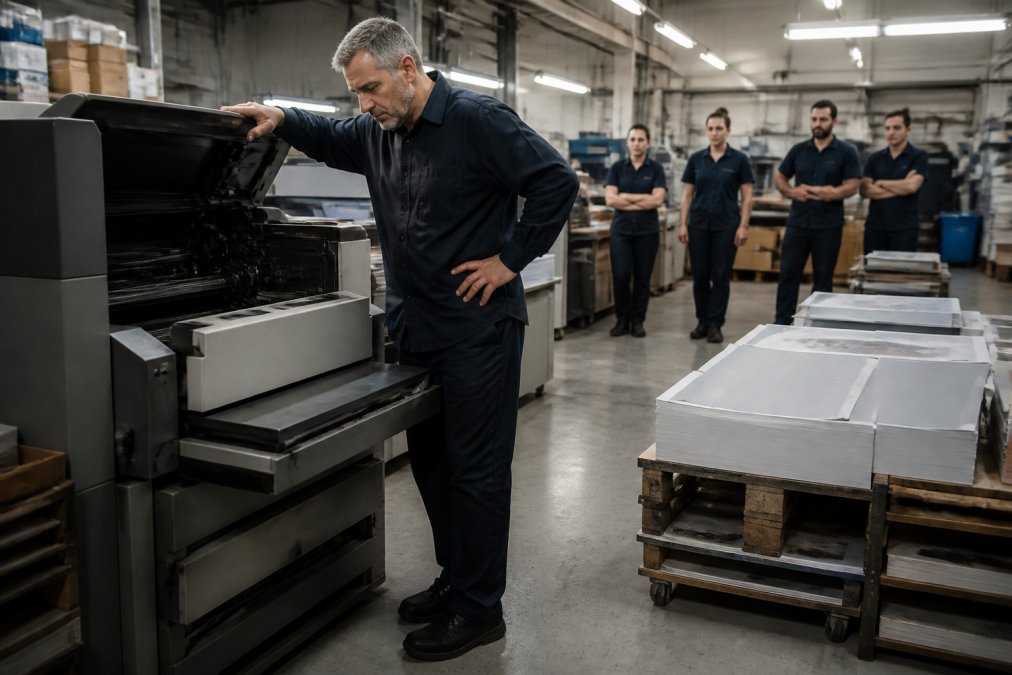
The most significant cost in any printer downtime impact on business productivity analysis is the revenue lost when your equipment isn't running.
Lost production revenue and missed deadlines
If your business depends on printing, whether it's commercial printing, apparel decoration, sign manufacturing, or laser engraving, downtime directly reduces revenue. A DTF printer down for three days loses three days of production. If that printer typically generates £400 per day, the downtime costs £1,200 in lost revenue.
Worse, missed deadlines damage customer relationships. A client expecting delivery on Friday but receiving it the following Tuesday may not return. That's not just lost revenue on one job, it's lost future revenue from a dissatisfied customer.
Staff allocation and workflow disruption
When equipment fails, your team doesn't simply wait. They either attempt workarounds (printing on alternative equipment, outsourcing jobs, or delivering late) or they sit idle. Sitting idle is pure cost: you're paying wages for work that isn't happening.
Building Your Cost Benefit Analysis Framework
To determine whether a service contract makes financial sense, you need a structured approach.
Calculating annual repair costs for your current setup
Start by examining your repair history. How many times per year does your equipment fail? What does each repair typically cost?
Quantifying downtime losses and productivity impact
For each failure, estimate how long your equipment is typically down. If repairs take an average of five working days (including time waiting for parts and technician availability), and your equipment generates £400 per day in production value, each failure costs £2,000 in lost revenue.
Comparing contract costs against projected savings
Now compare this to a service contract. A comprehensive contract covering your equipment might cost £400 per month (£4,800 annually) with all parts and labour included, and a 24-hour response time guarantee.
Under this contract:
- You eliminate the £1,250 in reactive repair costs (covered by the contract)
- You reduce downtime from five days to one day per failure (faster response), cutting downtime costs from £4,000 to £800
- You reduce workflow disruption by 80% because equipment is back online faster, cutting that cost from £1,000 to £200
Making the Decision: When a Service Contract Makes Financial Sense
Not every operation benefits from a service contract. The decision depends on your specific circumstances.
High-volume production environments
If your facility runs multiple shifts, produces high-volume output, and depends on continuous equipment operation, a service contract is almost always justified. The downtime cost of even a single failure often exceeds the annual contract cost. Laserprints' call-out service at £125 per visit is economical for operations where downtime costs far exceed that amount.
Multi-engine facilities with diverse equipment
Managing laser, DTF, and UV printers across a single facility multiplies your downtime risk. Each machine is a potential failure point. A comprehensive service contract covering all equipment types simplifies support: one supplier, one point of contact, consistent response times.
Tight margin businesses where downtime is costly
Some operations run on thin margins where every day of production directly impacts profitability. A sign manufacturer taking custom orders, an apparel decorator fulfilling rush jobs, or a commercial printer working on tight deadlines can't afford extended downtime.
Frequently Asked Questions
What is included in a standard printer service contract?
Standard printer service contracts typically cover scheduled preventative maintenance, emergency call-out visits, parts replacement, and labour costs. Coverage varies by provider and contract tier. Some contracts include remote support (£24.99 per session) for software issues, whilst others require on-site call-out services (£125 per visit). In-house repair services (£100 per service) may be bundled for DTF and UV printers. Always clarify what's included before signing, some contracts exclude consumables like ink or exclude certain repair types.
How do I calculate the total cost of ownership for industrial printers?
Total cost of ownership includes equipment purchase price, annual maintenance and service contract costs, spare parts and consumables, and the cost of downtime (lost revenue and staff time). Start by tracking your actual repair costs over 12 months, then add the cost of each hour of downtime multiplied by your average hourly production value. Compare this total against the annual cost of a service contract. For example, if your laser printer breaks down for 20 hours per year and you lose £500 per hour in production, that's £10,000 in downtime costs alone, often justifying a maintenance contract.
What are the risks of operating without a printer service agreement?
Without a service agreement, you face unpredictable repair costs, longer downtime whilst waiting for an engineer, potential damage from DIY repair attempts, and no guarantee of rapid response during critical production periods. Unplanned breakdowns can strand your equipment for weeks if parts need ordering, and emergency call-out charges (£125+) stack quickly. For multi-engine facilities, the lack of preventative maintenance increases the risk of catastrophic failures affecting laser, DTF, and UV equipment simultaneously.
How does a cost-per-print model compare to ad-hoc repairs?
A cost-per-print model spreads costs predictably across your production volume, making budgeting easier. Ad-hoc repairs create financial uncertainty, a single printhead cleaning (£49.99) or in-house repair (£100+) can escalate if parts are damaged or multiple faults emerge. However, if your facility runs low volumes or has minimal downtime history, ad-hoc repairs may be cheaper. Calculate your annual repair history to determine which model suits your business.